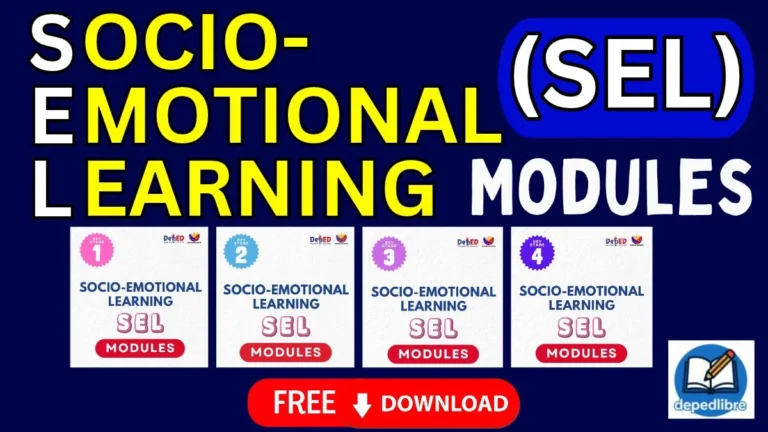
Socio-Emotional Learning Module DepEd
Socio-Emotional Learning Module DepEd: Your Complete Guide for Filipino Teachers (Free Download)
If you’ve been hearing more and more about Socio-Emotional Learning in school meetings, division memos, and professional development trainings lately — you’re not imagining things. The Department of Education (DepEd) has made SEL a major priority, especially under the MATATAG Curriculum, and rightfully so. Our learners today are navigating pressures that go far beyond math drills and reading comprehension. Bullying, anxiety, family struggles, and social disconnection are real classroom challenges — and SEL is one of the most powerful tools we have to address them.
In this guide, we’ll break down everything you need to know about the Socio-Emotional Learning Module for DepEd teachers — what SEL actually is, how it connects to the MATATAG curriculum and DepEd policies, what the five core competencies look like in a Filipino classroom, and how you can start applying SEL strategies today.
And yes — you can download the SEL module for free. More on that at the end.
Table of Contents
What Is Socio-Emotional Learning (SEL)?
Socio-Emotional Learning, or SEL, is the process through which learners (and educators) develop the skills to understand and manage emotions, build healthy relationships, make responsible decisions, and show empathy toward others.
The most widely used framework comes from CASEL — the Collaborative for Academic, Social, and Emotional Learning — which defines SEL around five core competencies:
CASEL Competency | What It Means |
Self-Awareness | Recognizing your own emotions, values, and how they affect behavior |
Self-Management | Regulating emotions, setting goals, showing resilience and discipline |
Social Awareness | Empathizing with others, respecting diversity, understanding social norms |
Relationship Skills | Communicating clearly, working in teams, resolving conflicts peacefully |
Responsible Decision-Making | Making constructive and ethical choices about personal and social behavior |
These five competencies are not abstract ideals — they are teachable, measurable, and deeply connected to academic success and life outcomes. In fact, a CASEL meta-analysis of research involving more than 97,000 students showed that pupils exposed to SEL programs performed higher academically than their counterparts. pshe-association
Download here the Socio-Emotional Learning Module DepEd for All Grade Levels!
Why SEL Matters for Filipino Learners
Let’s be honest: Filipino classrooms are complex spaces. Teachers often manage 40–50 learners per class, many of whom carry invisible emotional baggage to school each day.
DepEd monitored physical bullying in the majority of the 7,742 cases logged in school year 2022–2023. That’s not just a discipline problem — it’s a social-emotional one. And employers are noticing, too. Employers at a recent career expo organized by DepEd were looking for emotional skills being advocated through the SEL framework. asianewsasianews
Research also points to a growing mental health concern. Anxiety and depression among Filipino youth have been rising, and schools are often the first place where these issues become visible. SEL gives teachers structured, evidence-based tools to respond — not just react.
Beyond individual classrooms, there is a cultural dimension that makes SEL especially meaningful for us. Filipino values like malasakit (genuine concern for others), pakikipagkapwa-tao (solidarity and shared humanity), and paggalang (respect) are already deeply aligned with SEL’s core competencies. SEL doesn’t replace Filipino values — it gives them a framework and a language.
DepEd’s SEL Initiatives: What’s Already Happening
DepEd has been steadily building its SEL ecosystem over the past few years. Here’s a quick overview of the key programs and policies:
- The MATATAG Curriculum and SEL
The MATATAG Curriculum emphasizes the socio-emotional skills of Kindergarten to Grade 3 learners, thus decongesting the curriculum and focusing on holistic development. SEL is not a stand-alone subject under MATATAG — it is woven into the DNA of the curriculum itself, from how lessons are structured to how character formation is integrated across subject areas. senate
The MATATAG curriculum aims to foster the holistic development of learners, addressing their cognitive, socio-emotional, and physical well-being.
- The ExSELLEnT Framework
SEAMEO INNOTECH and ChildFund Philippines, together with DepEd Philippines, developed a contextualized SEL framework for Filipino learners — designed to help them grow, socially and emotionally, in a way that fits their values, culture, and everyday experiences. Published in 2025, the ExSELLEnT framework is the Philippines’ own localized adaptation of global SEL models, making it far more relevant to the realities of Filipino learners than a direct import of Western frameworks. seameo
The Filipino Social and Emotional Learning (SEL) competency framework identifies the social and emotional competencies all students should learn to be able to achieve their life goals. asianews
- NEAP’s Self-Paced SEL Modules for School Leaders and Teachers
The National Educators Academy of the Philippines (NEAP) has made self-paced modules for “Creating Caring School Communities: A Capacity Building for Socio-Emotional Learning (SEL)-Driven School Leaders” accessible through the NEAP Learning Management System (LMS) Portal. Teachers are accorded a maximum period of six months to accomplish the modules at their own pace. depeddasma
This is a significant development: DepEd is investing not just in student-facing SEL, but in building the teacher as the primary agent of social-emotional development in schools.
- Integration with Edukasyon sa Pagpapakatao (EsP)
SEL competencies are formally integrated into the Edukasyon sa Pagpapakatao (EsP) curriculum, aligned with DepEd’s Child Protection Policy and broader learner welfare mandates. This means every EsP teacher is, in effect, already a frontline SEL implementer — whether or not the term “SEL” appears in their lesson plan.
- Psychosocial Support in Conflict and Disaster Contexts
A one-year pilot program in Talisay City is empowering ECCE teachers to deliver vital Social-Emotional Learning (SEL) in disaster-prone communities, testing a scalable model to build early childhood resilience. This reflects how seriously DepEd is taking SEL as an equity and resilience tool — not just a classroom enrichment program. tribune
What Does an SEL Module for DepEd Teachers Look Like?
Whether you are working through the NEAP portal, using a school-developed module, or exploring materials from organizations like ChildFund or SEAMEO INNOTECH, a DepEd-aligned SEL module typically includes the following:
Module Structure
- Learning Objectives — Aligned to specific SEL competencies (e.g., self-awareness, responsible decision-making)
- Background Reading — Explains the theory and research behind SEL, contextualized for Filipino settings
- Reflection Activities — Prompts that ask teachers to examine their own social-emotional competencies first
- Classroom Application Strategies — Concrete activities and routines you can embed in daily instruction
- Discussion Questions — For PLCs (Professional Learning Communities) or LAC sessions
- Self-Assessment — Tracks personal growth across the five competencies
- Action Planning — A simple, realistic plan for applying SEL in your specific context
Teacher Tip: SEL modules are most effective when teachers don’t just read them — but experience them. If a module asks you to journal about a time you struggled to manage your own emotions, don’t skip it. That reflection is the module doing its job.
The 5 CASEL Competencies in a Filipino Classroom: Practical Examples
Let’s bring the five competencies to life with examples that Filipino teachers will actually recognize:
Self-Awareness
What it looks like: A Grade 6 learner notices they feel angry when called on unexpectedly. Instead of lashing out, they recognize the feeling and name it.
Classroom strategy: Use “emotion check-ins” at the start of class. Ask learners to hold up a number (1–5) showing how they feel today, no explanation needed.
Self-Management
What it looks like: A learner who normally shouts during arguments takes three deep breaths before responding during a group project conflict.
Classroom strategy: Teach and practice simple breathing exercises. Post a “Calm Down Corner” with visual cues for self-regulation strategies.
Social Awareness
What it looks like: A learner defends a classmate who is being teased — not because a teacher told them to, but because they genuinely feel for their peer.
Classroom strategy: Use collaborative readings and stories featuring diverse Filipino characters. Discuss: “How do you think this character felt? Why?”
Relationship Skills
What it looks like: During a group activity, learners take turns speaking, actively listen, and resolve disagreements without name-calling.
Classroom strategy: Use structured cooperative learning routines. Explicitly teach and model the language of respectful disagreement.
Responsible Decision-Making
What it looks like: A learner considers the consequences before joining a group of peers who are planning to skip afternoon classes.
Classroom strategy: Use case studies and “What Would You Do?” scenarios during EsP, GMRC, or advisory periods. Connect decisions to Filipino values.
Share to your friends!
Download more Deped files below!


Disclaimer:
Some educational materials may be inspired by or aligned with DepEd curriculum standards.
However:
All materials uploaded or created are intended to support teachers and students.
If any copyrighted content is unintentionally shared, please contact us here depedlibre@gmail.com immediately for removal or proper attribution.
We respect intellectual property rights and respond promptly to valid copyright concerns.
Looking for more teaching materials for SY 2026–2027? Here are related resources you might find useful:
- Download here ILAW Lesson Plans for all Grade Levels!
- Download here the Bulletin board designs for all Grade Levels!
- Download here the Summative Tests Term 1 and Term 2!
- Download here the Learning Activity Sheets (LAS) — for All Subjects!
- ILAW Lesson Plan Template (Blank, Editable .docx)
- Download here the MATATAG Budget of Work (BOW) Complete — SY 2026–2027!
Common Questions Filipino Teachers Ask About SEL
“Is SEL a separate subject I need to teach?”
No. SEL is most effective when it is integrated — woven into the way you teach your subject, not bolted on as an extra lesson. You can embed SEL into classroom routines, transitions, groupwork norms, and feedback practices.
“Do I need special training to do SEL?”
You’re already doing a lot of it. If you greet students by name, check in when a learner seems off, or use praise that builds confidence — that’s SEL. Formal modules and training help you become more intentional and systematic about it.
“How does SEL connect to DepEd’s mental health policy?”
SEL and mental health are deeply connected. DepEd’s mental health policy (Republic Act 11036 and its implementing rules) calls for school-based mental health programs. SEL is the preventive, universal layer — it builds resilience before problems escalate to the point of needing clinical intervention.
“What about the MATATAG curriculum — does SEL apply there?”
Absolutely. The MATATAG curriculum explicitly addresses the holistic development of learners, including their socio-emotional well-being. SEL is not separate from MATATAG — it is one of the foundations on which the reformed curriculum is built.
Tags
Don’t forget to Follow our Facebook page for more free learning materials!
Latest News!
Download more files below!
- Adviser Files
- Aral Program Materials
- Brigada Eskwela Files
- COT Lesson Plans
- Daily Lesson Log (DLL)
- Deped Files
- Deped Modules
- FREE CPD webinars
- FREE NEAP Trainings and Webinar
- Graduation Program/Files
- Homeroom Guidance Modules
- Matatag Curriculum Guide
- Matatag Lesson Exemplars
- National Learning Camp Files
- NAT Reviewer (New)
- Periodical Test (All Subjects)
- PowerPoint Game Templates
- Summative Tests/ Perfor Task
- Teacher Loans
Recent Posts
Download (by grade level)!
Grade 9 Files
Grade 10 Files
Grade 11 Files
Grade 12 Files