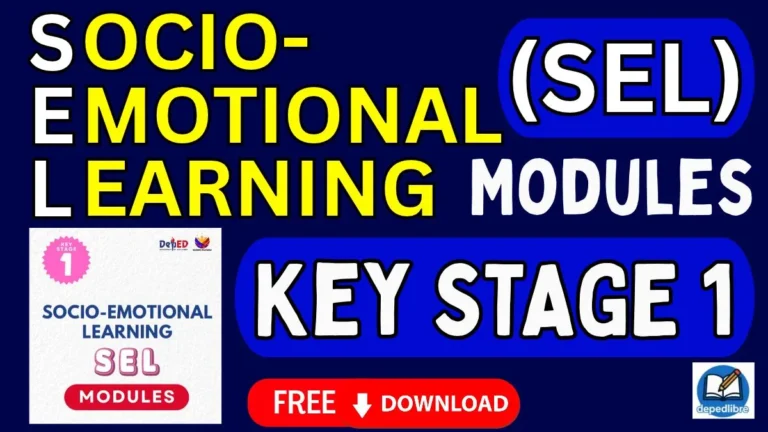
Socio-Emotional Learning Module DepEd Key Stage 1
Socio-Emotional Learning Module DepEd Key Stage 1 (Kinder to Grade 3): Free Download
Every teacher in Kinder to Grade 3 knows this scene. A Grade 1 pupil cries because someone took her pencil. A Kinder boy hits his seatmate because he doesn’t have the words for “I’m angry.” A Grade 3 child refuses to join group work because he’s afraid to be wrong.
These are not discipline problems. They are socio-emotional learning (SEL) moments, and they are the real reason many children struggle to read, count, or focus.
This post explains what SEL looks like in Key Stage 1, how it fits the MATATAG curriculum, and how you can use our free Socio-Emotional Learning Module for Key Stage 1.
Good news for teachers: The module is 100% free to download. No payment and no sign-up wall. Scroll to the download section or click the button below.
Table of Contents
What Is Socio-Emotional Learning in the Philippine Context?
Socio-emotional learning is the process of helping children recognize their feelings, manage them, understand other people, and make good choices. It is the “heart” side of learning, working alongside the “head” side.
Most Philippine SEL materials use the five competencies popularized by CASEL, which we’ve paired with Filipino terms below:
Competency | Filipino term | What it looks like in a young learner |
Self-awareness | Pagkilala sa sarili | “I feel sad because my friend didn’t play with me.” |
Self-management | Pamamahala sa sarili | Takes a deep breath before crying or shouting |
Social awareness | Kamalayang panlipunan | Notices that a classmate is sad and asks why |
Relationship skills | Pakikipagkapwa / Pakikisama | Shares, takes turns, says “pwede bang makigamit?” |
Responsible decision-making | Responsableng pagpapasya | Chooses to tell the truth, even when scared |
There is also a homegrown option. The Filipino SEL framework developed by ChildFund Philippines names six competencies: pagkilala sa sarili, pamamahala sa sarili, pagiging responsable, pagsisikap, pakikisama, and pagmamalasakit. Our module uses the five CASEL competencies as its backbone and weaves in pagsisikap and pagmamalasakit in the activities.
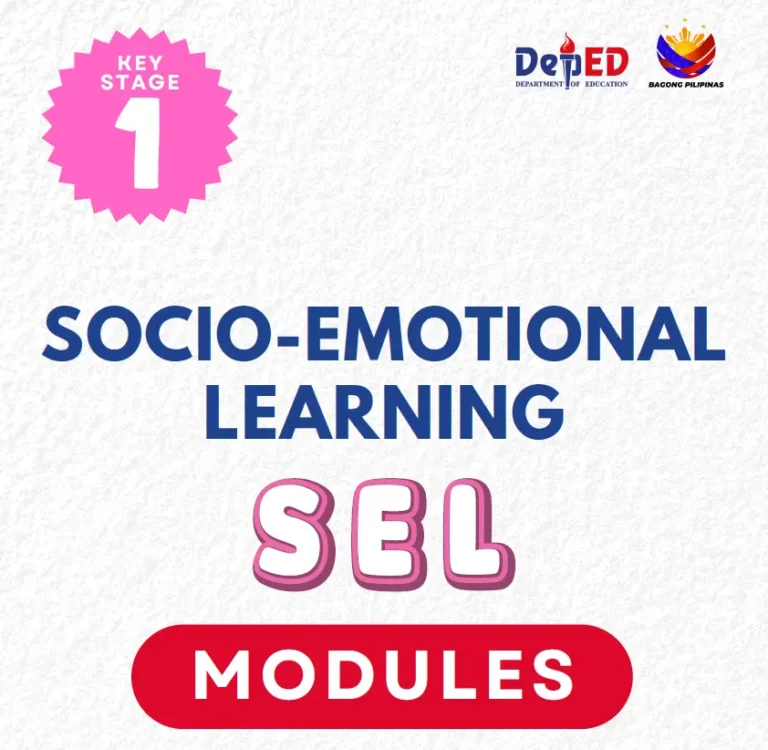
Download here the Socio-Emotional Learning Module DepEd for All Grade Levels!
Why SEL Matters Most in Key Stage 1
Key Stage 1 covers Kindergarten to Grade 3. When DepEd launched the MATATAG curriculum, it said it would give greater emphasis to foundational skills for these grades: literacy, numeracy, and socio-emotional skills. That is a clear signal that SEL is part of the core mission for these years.
Here is why it matters in practice:
- Young children can’t learn when they’re dysregulated. A child who is anxious or angry has little attention left for phonics or number sense.
- Habits form early. Turn-taking, calming down, and asking for help are easier to teach at age 5 than at age 15.
- It supports GMRC. The GMRC and Values Education Act (RA 11476) pushes character formation, and SEL gives teachers concrete routines for it.
- It reduces classroom stress for you. Teachers who use short daily SEL routines often report smoother transitions and fewer conflicts. This is a common classroom experience rather than a guarantee, so see how it works in your own room.
DepEd’s own officials have framed SEL as a way to make learners more resilient and more aware of their mental health needs.
How SEL Fits the MATATAG Curriculum (Kinder to Grade 3)
Under MATATAG, Key Stage 1 learning is organized around a small number of core areas. Grade 1 pupils have five: Language, Reading and Literacy, Mathematics, Makabansa, and GMRC. Because there is no stand-alone “SEL subject,” the smart move is to integrate SEL into lessons you already teach.
Learning area | How to weave in SEL | Example |
Kindergarten (developmental domains) | The socio-emotional domain is already a core domain | Feelings check-in during circle time |
GMRC | Direct teaching of respect, honesty, and kindness | Role-play: “Paano humingi ng tawad?” |
Language / Reading and Literacy | Use stories with characters who feel and choose | Ask: “How did the character feel? What would you do?” |
Mathematics | Build perseverance and growth mindset | Celebrate mistakes: “Anong natutunan natin dito?” |
Makabansa | Teach belonging, community, and respect for differences | “Our class community” mural |
DepEd’s earlier guidance on integrating SEL also points the same way: SEL objectives should be linked to the competencies you already teach, SEL tasks should appear in the lesson plan, and learner responses should be processed so they deepen the skill. You can see this approach in a DepEd SEL training deck that references DepEd Order 34, s. 2022, which names SEL as a focal area of learning recovery.
Teacher tip: You don’t need extra minutes in your schedule. Ten minutes of morning circle plus one SEL question inside a reading or math lesson covers a lot.
What’s Inside Our Free Socio-Emotional Learning Module for Key Stage 1
We built this module for busy public school teachers who need something printable and ready. It is organized into three units so you can adjust it to your school’s term calendar.
Module contents at a glance
Section | What you get |
Teacher’s guide | Quick explanation of the SEL competencies and how to use the module |
Unit 1: Kilalanin Ko ang Sarili Ko | Naming feelings, “feelings faces” chart, my-body-signals activity |
Unit 2: Kaya Kong Pamahalaan ang Sarili Ko | Calm-down breathing, “calm corner” setup, simple coping steps |
Unit 3: Kasama Ko ang Kapwa Ko | Empathy stories, sharing and turn-taking games, friendship skills |
Sample lesson plans | Ready-to-teach plans for Kinder, Grade 1, Grade 2, and Grade 3 |
Printables | Feelings chart, emotion cards, classroom routine posters |
Assessment tools | Simple observation checklist and rubric for SEL behaviors |
Parent note | A short, friendly letter you can send home |
Sample activity: “Feelings Weather Report” (Kinder to Grade 1)
- Show a chart with weather symbols: sunny, cloudy, rainy, stormy.
- Ask each child to point to the “weather” inside them today.
- Invite two or three children to share why.
- Respond with simple empathy: “Salamat sa pagsabi. Pwede nating tulungan ang bawat isa.”
- Close with three deep breaths together.
Time: 5 to 8 minutes. Materials: one printable chart. Skill: self-awareness.
Sample activity: “Problem-Solving Steps” (Grade 2 to Grade 3)
Teach a four-step routine children can use during conflicts:
- Tigil (Stop and breathe)
- Isip (Think: what happened?)
- Sabihin (Say it with “I” words: “Nalungkot ako kasi…”)
- Piliin (Choose a fair solution together)
Post the four steps on the wall and reuse them all year.
How to Use the Module Step by Step
- Download and print the teacher’s guide and the printables you need.
- Start with a daily routine. Do a five-minute check-in each morning.
- Pick one SEL lesson per week and match it to a reading, GMRC, or Makabansa lesson.
- Model it yourself. Children copy how you handle frustration. Say aloud, “Naiinis ako ngayon, huminga muna ako.”
- Observe, don’t grade harshly. Use the checklist to note growth over time.
- Involve parents with the take-home note.
How to Assess SEL in Young Learners
SEL isn’t tested with a written exam, and it shouldn’t be. For Key Stage 1, think in terms of observable behaviors.
Rating | Descriptor | Example |
4: Consistently | Shows the skill on their own | Calms down without prompting |
3: Usually | Shows the skill with occasional reminders | Takes turns after one reminder |
2: Sometimes | Needs frequent guidance | Names feelings only with a picture chart |
1: Beginning | Needs close support | Struggles to name any feeling yet |
Keep notes short and kind. The goal is to see growth across the year, and these records can support conferences with parents. Check your school’s current grading and reporting guidelines, because assessment rules for Key Stage 1 have been changing under MATATAG.
Share to your friends!
Download more Deped files below!



Disclaimer:
Some educational materials may be inspired by or aligned with DepEd curriculum standards.
However:
All materials uploaded or created are intended to support teachers and students.
If any copyrighted content is unintentionally shared, please contact us here depedlibre@gmail.com immediately for removal or proper attribution.
We respect intellectual property rights and respond promptly to valid copyright concerns.
Looking for more teaching materials for SY 2026–2027? Here are related resources you might find useful:
- Download here ILAW Lesson Plans for all Grade Levels!
- Download here the Bulletin board designs for all Grade Levels!
- Download here the Summative Tests Term 1 and Term 2!
- Download here the Learning Activity Sheets (LAS) — for All Subjects!
- ILAW Lesson Plan Template (Blank, Editable .docx)
- Download here the MATATAG Budget of Work (BOW) Complete — SY 2026–2027!
Common Questions Filipino Teachers Ask About SEL
Is SEL the same as GMRC?
Not exactly. GMRC focuses on values and conduct. SEL gives children the emotional skills to live out those values. They work best together.
Do I need special training?
No. The activities are simple, and you can start with one routine. Your own calm example matters more than any script.
What about children who have experienced trauma or serious difficulties at home?
SEL routines help all learners, but they are not a replacement for professional support. If a child’s behavior worries you, follow your school’s child protection and referral procedures and involve your guidance counselor or school head.
Can I use this for multigrade classes?
Yes. The activities are flexible. Younger children use pictures and movement, while older ones add writing and discussion.
Can I share it with other teachers?
Yes, share it freely with fellow teachers. It’s free for everyone.
Tips to Make SEL Stick All Year
- Keep routines short, predictable, and positive.
- Use pictures and actions, since young children learn through concrete cues.
- Praise effort and kindness, not only correct answers.
- Create a calm corner with a few simple items. It is a reset space, never a punishment.
- Take care of your own well-being. Teachers who feel supported teach SEL better.
Tags
Don’t forget to Follow our Facebook page for more free learning materials!
Latest News!
Download more files below!
- Adviser Files
- Aral Program Materials
- Brigada Eskwela Files
- COT Lesson Plans
- Daily Lesson Log (DLL)
- Deped Files
- Deped Modules
- FREE CPD webinars
- FREE NEAP Trainings and Webinar
- Graduation Program/Files
- Homeroom Guidance Modules
- Matatag Curriculum Guide
- Matatag Lesson Exemplars
- National Learning Camp Files
- NAT Reviewer (New)
- Periodical Test (All Subjects)
- PowerPoint Game Templates
- Summative Tests/ Perfor Task
- Teacher Loans

Recent Posts
Download (by grade level)!
Grade 9 Files
Grade 10 Files
Grade 11 Files
Grade 12 Files