
DepEd Class Program for Key Stage 3 SY 2026 – 2027

DepEd Class Program for Key Stage 3 2026: The Complete Guide for Junior High School Teachers (Grades 7–10)
If you’re a Junior High School teacher — or a school administrator trying to finalize schedules before the school year kicks off — you already know how important it is to have your class program ready and fully aligned with the latest DepEd policies. And for SY 2026–2027, there’s a lot that’s new.
Between the phased rollout of the MATATAG Curriculum, the historic shift to a Three-Term School Calendar, and the integration of the ARAL Program into daily instruction, planning the class program for Key Stage 3 (Grades 7 to 10) has become more nuanced than ever before. The good news? This guide has everything you need — from the official DepEd policy references to downloadable templates you can use right away — all in one place.
Let’s walk through it together.
Table of Contents
What Is Key Stage 3 in the Philippine Education System?
Before we dive into schedules and policies, let’s make sure we’re on the same page. The Philippine K–12 curriculum organizes learning into four key stages:
Key Stage | Grade Levels | School Level |
Key Stage 1 | Kindergarten – Grade 3 | Elementary |
Key Stage 2 | Grades 4 – 6 | Elementary |
Key Stage 3 | Grades 7 – 10 | Junior High School (JHS) |
Key Stage 4 | Grades 11 – 12 | Senior High School (SHS) |
Key Stage 3, therefore, covers the entirety of Junior High School — the four formative years when students transition from childhood into adolescence, develop critical thinking, and begin to specialize in their academic interests.
“At Key Stage 3, the Opening Block is not simply about adjustment. It is a strategic period for aligning expectations, strengthening learner autonomy, and setting the foundation for academic success and responsible citizenship.” — DepEd Order No. 9, s. 2026
This is a developmentally significant stage, and the class program you design for it must reflect that weight.
Big Changes for SY 2026–2027: What Every JHS Teacher Must Know
- The Three-Term School Calendar Is Now Official
The most sweeping structural change for SY 2026–2027 is the replacement of the traditional four-quarter system with the new Three-Term School Calendar, officially mandated through DepEd Order No. 9, s. 2026.
This isn’t just a cosmetic tweak to the calendar. It’s a comprehensive restructuring of how instructional time is organized across the school year — and it directly affects how you build your class program.
Here’s what the new calendar looks like:
Term | Duration | Key Focus |
Term 1 | June 8 – September 15, 2026 | Foundational competencies under MATATAG |
Term 2 | September 16 – December 18, 2026 | Mid-year intensive instruction; break during peak typhoon season |
Term 3 | January 4 – April 8, 2027 | Final term; leads into year-end ceremonies |
EOSY Break | April 9 – May 9, 2027 | End-of-School-Year break |
Total Class Days: 201
Each term is divided into three distinct phases:
- Opening Block — Learner profiling, readiness assessments, diagnostic checks, and initial orientation
- Instructional Block — Focused, uninterrupted teaching and learning; ARAL remediation sessions are embedded here
- End-of-Term Block — Grade computation, co-curricular activities, school-level competitions, teacher professional development, and wellness breaks
Why the change? According to DepEd, a review of the four-quarter system revealed recurring class disruptions that compressed instructional time, contributed to learning gaps, increased teacher workload, and reduced learning engagement — especially among vulnerable learners. The three-term structure is designed to provide longer, more focused instructional periods and reduce non-teaching-related tasks.
Download here the DepEd Class Program for Key Stage 3 SY 2026 – 2027!
2. The MATATAG Curriculum Reaches Key Stage 3 in Full by SY 2026–2027
The MATATAG Curriculum — formally introduced through DepEd Order No. 10, s. 2024 — has been rolling out in phases since SY 2024–2025. Here’s the Key Stage 3–specific timeline you need to know:
School Year | Grades Adopting MATATAG in JHS |
SY 2024–2025 | Grade 7 |
SY 2025–2026 | Grade 8 |
SY 2026–2027 | Grades 9 and 10 |
SY 2027–2028 | Full implementation, K–10 |
This means that by SY 2026–2027, Grades 7 and 8 are already running under MATATAG, and Grades 9 and 10 will officially transition to MATATAG learning competencies. For class program planning, this matters because the MATATAG Curriculum brings revised learning area objectives, updated time allotments, and new approaches to assessment.
What does MATATAG stand for? It’s actually an acronym built on four pillars:
- Makabansa (Patriotic)
- Matao (People-Centered)
- Mahas (Competent)
- Matatag (Resilient)
These values aren’t just branding — they’re woven into every learning area’s competencies and performance standards across all Key Stages.
Share to your friends!
Key Stage 3 Learning Areas: Subjects and Time Allotment
One of the most searched pieces of information is: how many minutes per subject? Here is the breakdown for Key Stage 2 based on the latest DepEd guidelines under the MATATAG Curriculum and Three-Term Calendar:
Weekly Time Allotment — Key Stage 2 (Grades 4–6)
Learning Area | Weekly Minutes | Daily Average |
Filipino | 300 min | 60 min |
English | 300 min | 60 min |
Mathematics | 300 min | 60 min |
Science | 300 min | 60 min |
Araling Panlipunan (AP) | 180 min | ~36 min |
Edukasyon sa Pagpapakatao (EsP) | 120 min | ~24 min |
MAPEH (Music, Arts, PE, Health) | 240 min | ~48 min |
EPP / TLE (Edukasyong Pantahanan at Pangkabuhayan) | 180 min | ~36 min |
ARAL Program / Intervention | Embedded | Within school day |
Homeroom Guidance Program (HGP) | Embedded | Within school day |
⚠️ Important Note: The ARAL Program and Homeroom Guidance Program are not graded subject areas. They are intervention and support programs embedded within the class schedule. Teachers record participation but do not include them in the academic grade computation.
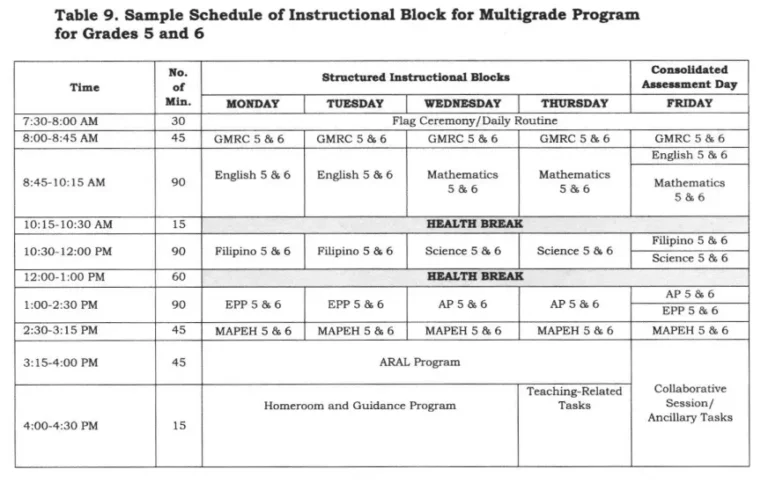
A Practical Sample Daily Schedule (Key Stage 2)
Here is a sample daily flow that aligns with the DepEd guidelines for a 7:00 AM – 1:00 PM school session:
Time | Activity |
7:00 – 7:10 AM | Flag Ceremony / Morning Routine |
7:10 – 8:10 AM | English |
8:10 – 9:10 AM | Mathematics |
9:10 – 9:30 AM | Recess Break |
9:30 – 10:30 AM | Filipino |
10:30 – 11:30 AM | Science |
11:30 AM – 12:00 NN | AP / EsP / MAPEH / EPP (rotated) |
12:00 – 12:30 PM | Lunch Break |
12:30 – 1:00 PM | ARAL Program / HGP / Intervention |
🗒️ This is a sample layout. Your school may adjust the sequence of subjects as long as the total time allotment per learning area is maintained.


The ARAL Program: Why It's a Non-Negotiable Part of Your Class Program
One element of the class program for SY 2026–2027 that cannot be overlooked is the Academic Recovery and Accessible Learning (ARAL) Program, now anchored in law through Republic Act 12028 (ARAL Act of 2024) and operationalized in basic education through DepEd Order No. 18, s. 2025.
The ARAL Program is a structured reading intervention initiative embedded into the regular school day. For Key Stage 3, it is specifically designed to strengthen learners’ transition from basic reading to independent reading, fluency, and deep comprehension — skills that are essential for academic success across all eight learning areas.
What the ARAL Program Looks Like in Key Stage 3
- Uses teacher-guided lessons, interactive activities, and structured reading materials
- Targets learners who have not yet reached grade-level reading competencies
- Provides progressive skill development: from decoding and fluency at lower stages to critical analysis and independent reading at Key Stage 3
- Is embedded within the Instructional Block — meaning it should appear in your daily class program, not treated as an afterthought
If you’re wondering where to fit the ARAL Program in a full JHS schedule, the DepEd sample class programs in DO No. 009, s. 2026 include specific scheduling models you can reference.
Disclaimer:
Some educational materials may be inspired by or aligned with DepEd curriculum standards.
However:
All materials uploaded or created are intended to support teachers and students.
If any copyrighted content is unintentionally shared, please contact us here depedlibre@gmail.com immediately for removal or proper attribution.
We respect intellectual property rights and respond promptly to valid copyright concerns.
Frequently Asked Questions About the DepEd Key Stage 3 Class Program 2026
Q: Can schools create their own class program format? Yes. DepEd allows schools to modify the format and layout of the class program as long as all required information (learning areas, time allotments, signatories) is retained. The sample programs in DO No. 009, s. 2026 are guides, not rigid templates.
Q: Are the ARAL materials for Key Stage 3 free? Yes. ARAL Program reading materials for Key Stage 3 (Grades 7–10) are provided free of charge. These include structured reading interventions aligned with JHS academic demands.
Q: Do private schools have to follow the Three-Term Calendar? Private schools have flexibility but may adopt the Three-Term Calendar guidelines as long as they do not deviate from the required number of class days (201) and other applicable laws, including RA 11480.
Q: Where do I get the official MATATAG Curriculum Guides for Grade 9 and 10? The full K to 10 Curriculum Guides are accessible via the DepEd official website or at the direct link: http://tinyurl.com/MATATAGFullCGsK-10.
Q: What’s the difference between Core and Skill-based subjects in the ECR? In the Electronic Class Record for Key Stage 3, Core subjects (Filipino, English, Math, Science, AP, Values Education) follow one weighting formula, while Skill-based subjects (MAPEH and TLE) follow a different weighting that places more emphasis on performance tasks and practical outputs.
Don’t forget to Follow our Facebook page for more free learning materials!
Latest News!
Download more files below!
- Adviser Files
- Aral Program Materials
- Brigada Eskwela Files
- COT Lesson Plans
- Daily Lesson Log (DLL)
- Deped Files
- Deped Modules
- Graduation Program/Files
- Homeroom Guidance Modules
- Matatag Curriculum Guide
- Matatag Lesson Exemplars
- National Learning Camp Files
- NAT Reviewer (New)
- Periodical Test (All Subjects)
- PowerPoint Game Templates
- Summative Tests/ Perfor Task
- Teacher Loans


Recent Posts
Download (by grade level)!
Grade 9 Files
Grade 10 Files
Grade 11 Files
Grade 12 Files