
DepEd Class Program for Key Stage 2 SY 2026 – 2027

DepEd Class Program for Key Stage 2 (2026): Complete Guide for Grades 4–6 + Free Download
If you’re a teacher, school head, or parent trying to make sense of the DepEd Class Program for Key Stage 2 in 2026, you’ve come to the right place. With the rollout of the MATATAG Curriculum fully in gear and the historic shift to a Three-Term School Calendar for SY 2026–2027, there’s a lot to unpack. This guide breaks it all down — from subject listings and time allotments, to how multigrade classes work, and where to get your free downloadable templates.
Let’s get started.
All Class Program files mentioned in this article are available for FREE download. Scroll to the Download Section at the bottom of this page to get your copy.
Table of Contents
1. What Is Key Stage 2 in DepEd's Curriculum?
If you’re a Grade 4, 5, or Grade 6 teacher — or a parent with a child in upper elementary school — then Key Stage 2 is exactly where your learner stands. In the Philippine Department of Education (DepEd) framework, the basic education curriculum is divided into four key stages:
Key Stage | Grade Levels | Focus |
Key Stage 1 | Kindergarten – Grade 3 | Foundational literacy and numeracy |
Key Stage 2 | Grades 4–6 | Building fluency, critical thinking, and subject-specific knowledge |
Key Stage 3 | Grades 7–10 | Junior High School |
Key Stage 4 | Grades 11–12 | Senior High School |
Key Stage 2 is a critical bridge. Learners are no longer just learning how to read — they are now reading to learn. This is the stage where subjects like Science, Mathematics, Araling Panlipunan, and MAPEH begin to demand deeper thinking skills, and where a well-structured class program becomes absolutely essential for both teachers and students.
2. The Big Change for 2026: Three-Term School Calendar
Before we talk about the class program itself, there is one major context you need to understand: the entire school calendar has changed.
Through DepEd Order No. 009, s. 2026, the Department of Education officially replaced the old four-quarter school calendar with a new Three-Term School Calendar, effective School Year 2026–2027. This isn’t just a rebranding — it’s a structural reform that directly shapes how every class program is built.
Why the Change?
DepEd identified several problems with the old four-quarter system:
- Recurring class disruptions that compressed instructional time
- Increased teacher workload due to frequent summative assessments
- Learning gaps among vulnerable learners caused by fragmented instruction
- Reduced learner engagement, especially in the lower grade levels
The Three-Term Calendar addresses all of these by giving teachers longer, uninterrupted stretches of instructional time.
How the New Calendar Is Structured
Each of the three terms is composed of three blocks:
- Opening Block — Orientation, enrollment processing, classroom setup, and community-building activities
- Instructional Block — The main teaching and learning period; this is where the regular class program runs
- End-of-Term Block — Summative assessments, remediation, ARAL Program sessions, co-curricular activities, and the mandated Wellness Break
“DepEd Order No. 009, s. 2026 formally adopts the Three-Term School Calendar to protect instructional time, reduce class disruptions, and strengthen learning recovery efforts.”
The school year consists of 201 class days, and the time allotment for every learning area averages 60 minutes per session under this new structure.
Download here the DepEd Class Program for Key Stage 2 SY 2026 – 2027!
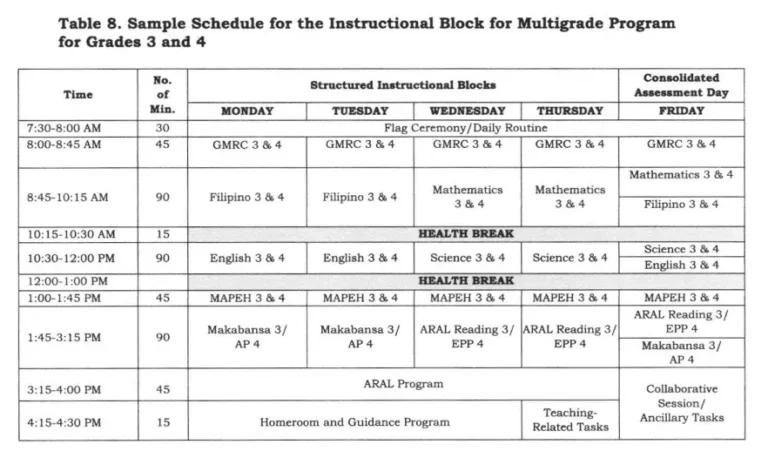
3. Official DepEd Class Program for Key Stage 2 (SY 2026–2027)
The Sample Class Schedule for Key Stage 2 was officially released as part of DepEd Order No. 009, s. 2026. This document serves as the standard reference for all public elementary schools handling Grades 4–6.
It is important to clarify what the term “sample” means here. DepEd provides a model class program — schools are allowed to modify the format and include required teacher and class information based on their actual needs and context. However, schools are not allowed to remove any required information, and they must comply strictly with the prescribed time allotments.
Key Requirements for the Class Program
- The Class Program and Teacher’s Schedule must be submitted to the PSDS In-Charge before the start of each term
- The schedule must comply with DepEd Order No. 10, s. 2025, which governs teacher working hours
- All programs must reflect 8-hour teacher workdays
- Learners must receive 300 minutes of instruction daily, with a separate 1-hour break for recess and lunch
Two-Shift Class Programs
For schools operating on a two-shift schedule (morning and afternoon), a separate version of the class program applies. The most important requirement is that all required learning areas and intervention programs still be accommodated within the shorter daily window.
Share to your friends!
4. Subject Time Allotment for Grades 4, 5, and 6
One of the most searched pieces of information is: how many minutes per subject? Here is the breakdown for Key Stage 2 based on the latest DepEd guidelines under the MATATAG Curriculum and Three-Term Calendar:
Weekly Time Allotment — Key Stage 2 (Grades 4–6)
Learning Area | Weekly Minutes | Daily Average |
Filipino | 300 min | 60 min |
English | 300 min | 60 min |
Mathematics | 300 min | 60 min |
Science | 300 min | 60 min |
Araling Panlipunan (AP) | 180 min | ~36 min |
Edukasyon sa Pagpapakatao (EsP) | 120 min | ~24 min |
MAPEH (Music, Arts, PE, Health) | 240 min | ~48 min |
EPP / TLE (Edukasyong Pantahanan at Pangkabuhayan) | 180 min | ~36 min |
ARAL Program / Intervention | Embedded | Within school day |
Homeroom Guidance Program (HGP) | Embedded | Within school day |
⚠️ Important Note: The ARAL Program and Homeroom Guidance Program are not graded subject areas. They are intervention and support programs embedded within the class schedule. Teachers record participation but do not include them in the academic grade computation.
A Practical Sample Daily Schedule (Key Stage 2)
Here is a sample daily flow that aligns with the DepEd guidelines for a 7:00 AM – 1:00 PM school session:
Time | Activity |
7:00 – 7:10 AM | Flag Ceremony / Morning Routine |
7:10 – 8:10 AM | English |
8:10 – 9:10 AM | Mathematics |
9:10 – 9:30 AM | Recess Break |
9:30 – 10:30 AM | Filipino |
10:30 – 11:30 AM | Science |
11:30 AM – 12:00 NN | AP / EsP / MAPEH / EPP (rotated) |
12:00 – 12:30 PM | Lunch Break |
12:30 – 1:00 PM | ARAL Program / HGP / Intervention |
🗒️ This is a sample layout. Your school may adjust the sequence of subjects as long as the total time allotment per learning area is maintained.


5. MATATAG Curriculum Implementation in Key Stage 2
The MATATAG Curriculum is DepEd’s flagship curriculum reform, introduced through DepEd Order No. 10, s. 2024. It is being rolled out in phases across all grade levels, and Key Stage 2 is right in the middle of this transition.
Phase Implementation Chart for Key Stage 2
School Year | Grades Under MATATAG |
SY 2024–2025 | Grade 4 (Phase 1) |
SY 2025–2026 | Grades 4–5 (Phase 2 adds Grade 5) |
SY 2026–2027 | Grades 4–5–6 (Phase 3 completes Key Stage 2) |
This means that for SY 2026–2027, all three grade levels in Key Stage 2 will now be under the full MATATAG Curriculum. This is a landmark year for upper elementary education in the Philippines.
What Changes with MATATAG in the Class Program?
The MATATAG Curriculum is not just a new set of learning competencies. It brings with it a different instructional design philosophy:
- Quality over Quantity — Instead of covering a wide range of topics superficially, MATATAG focuses on deeper mastery of fewer, more essential competencies
- Active Learning — Teachers are encouraged to move away from passive lecture-based instruction and toward interactive, student-centered approaches
- Spiral Progression — Concepts build on each other across grade levels, so what a learner studies in Grade 4 directly connects to what they will study in Grade 5 and 6
- Differentiated Instruction — The reduced content load gives teachers more room to adjust their teaching to different learner needs within the allotted class time
The MATATAG Curriculum Guide for each learning area (available from the DepEd website) contains the official class program templates, time allotments, and lesson plan formats aligned with these principles.
Disclaimer:
Some educational materials may be inspired by or aligned with DepEd curriculum standards.
However:
All materials uploaded or created are intended to support teachers and students.
If any copyrighted content is unintentionally shared, please contact us here depedlibre@gmail.com immediately for removal or proper attribution.
We respect intellectual property rights and respond promptly to valid copyright concerns.
Frequently Asked Questions
Q: Is the Three-Term Calendar already in effect for SY 2026–2027? Yes. DepEd Order No. 009, s. 2026 took effect immediately upon its approval and publication, and applies to School Year 2026–2027 nationwide.
Q: Can schools create their own class program format? Yes, but with limits. Schools may modify the format and required teacher/class information based on actual needs. However, the required learning areas, time allotments, and signatories must follow the official DepEd guidelines.
Q: What happens to the ARAL Program if a learner doesn’t need remediation? The ARAL Program slot in the class program can be used for all learners — those who need intervention receive targeted support, while proficient learners may engage in enrichment activities during the same period.
Q: Is Grade 6 now under MATATAG? Yes! Starting SY 2026–2027, Grade 6 joins Grades 4 and 5 under the MATATAG Curriculum, completing the full Key Stage 2 implementation of the new curriculum.
Q: Where can I download the official Key Stage 2 class program? See the Free Download Section below. All files are available for free — no sign-up required.
Q: What is the grading weight for Science in Grade 4? For Core subjects like Science, the distribution is: Written Work (20%), Performance Tasks (50%), and Term Assessment (30%).
Don’t forget to Follow our Facebook page for more free learning materials!
Latest News!
Download more files below!
- Adviser Files
- Aral Program Materials
- Brigada Eskwela Files
- COT Lesson Plans
- Daily Lesson Log (DLL)
- Deped Files
- Deped Modules
- Graduation Program/Files
- Homeroom Guidance Modules
- Matatag Curriculum Guide
- Matatag Lesson Exemplars
- National Learning Camp Files
- NAT Reviewer (New)
- Periodical Test (All Subjects)
- PowerPoint Game Templates
- Summative Tests/ Perfor Task
- Teacher Loans



Recent Posts
Download (by grade level)!
Grade 9 Files
Grade 10 Files
Grade 11 Files
Grade 12 Files