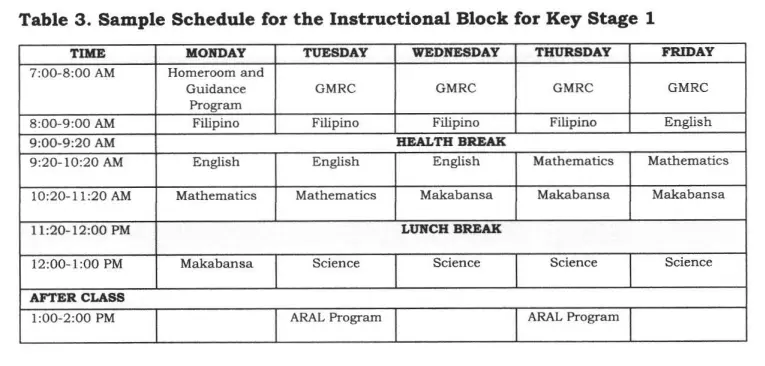
DepEd Class Program for Key Stage 1 SY 2026 – 2027

DepEd Class Program for Key Stage 1 (2026–2027): Complete Guide + Free Download
If you’re a teacher, school head, or parent trying to make sense of the DepEd Class Program for Key Stage 1 in 2026, you’ve come to the right place. With the rollout of the MATATAG Curriculum fully in gear and the historic shift to a Three-Term School Calendar for SY 2026–2027, there’s a lot to unpack. This guide breaks it all down — from subject listings and time allotments, to how multigrade classes work, and where to get your free downloadable templates.
Let’s get started.
Table of Contents
What Is Key Stage 1 in the DepEd Curriculum?
In the Philippine basic education system, Key Stage 1 (KS1) refers to the foundational years of schooling covering Kindergarten through Grade 3. This stage is widely regarded as the most critical period in a child’s academic development — it’s when young learners first develop core literacy, numeracy, social, and emotional skills.
Under DepEd Order No. 10, s. 2024 (the MATATAG Curriculum policy), the key stages are officially divided as follows:
Key Stage | Grade Levels | School Level |
Key Stage 1 (KS1) | Kindergarten – Grade 3 | Elementary |
Key Stage 2 (KS2) | Grades 4 – 6 | Elementary |
Key Stage 3 (KS3) | Grades 7 – 10 | Junior High School |
Key Stage 4 (KS4) | Grades 11 – 12 | Senior High School |
Think of Key Stage 1 as the “building blocks” phase — before a child can read a novel, they need to learn phonics. Before they can solve equations, they need to understand numbers. The DepEd Class Program for Key Stage 1 is the structured daily guide that organizes how and when those building blocks are laid.
What's New for SY 2026–2027?
School Year 2026–2027 brings two major changes that directly affect Key Stage 1 class programs:
- Full MATATAG Curriculum Rollout for Grades 1–3
The MATATAG Curriculum — DepEd’s revised K–10 framework designed to address learning poverty and curriculum congestion — has been rolling out in phases since SY 2024–2025. By SY 2026–2027, Grades 3, 6, and 9 join the implementation timeline, making Key Stage 1 fully MATATAG-compliant for all three grade levels.
Here’s a quick look at the phased rollout:
School Year | Grade Levels Added |
2024–2025 | Kinder, Grades 1, 4, 7 |
2025–2026 | Grades 2, 5, 8 |
2026–2027 | Grades 3, 6, 9 ← We are here |
2027–2028 | Grade 10 (Full implementation) |
- The Three-Term School Calendar
Goodbye, four quarters. Hello, three terms! Under DepEd Order No. 009, s. 2026, the school year is now divided into three academic terms — each with an Opening Block, Instructional Period, and End-of-Term Block. This is not a “trimester system,” as DepEd clarified; it’s a restructuring of the school year for better learning continuity.
Download here the DepEd Class Program for Key Stage 1 SY 2026 – 2027!
Subjects Under Key Stage 1 (Grades 1–3) — MATATAG Curriculum
One of the headline changes in the MATATAG Curriculum is the streamlining of subjects, especially in the lower grades. Here’s what learners study at each grade level within Key Stage 1:
Kindergarten Learning Areas
Kindergarten does not follow a traditional subject breakdown. Instead, it focuses on six developmental domains:
- Socio-Emotional Development
- Values Development
- Aesthetic/Creative Development
- Physical Health and Motor Development
- Language, Literacy, and Communication Development
- Cognitive Development
Grade 1 Learning Areas
Subject | Notes |
Language (Reading and Literacy) | Foundational literacy in Filipino and English |
Mathematics | Early numeracy concepts |
Good Manners and Right Conduct (GMRC) | Character and values formation |
Makabansa | Filipino identity, culture, and nationalism |
📌 Note: Mother Tongue is no longer a standalone learning area under the MATATAG Curriculum. However, the mother tongue is still used as a medium of instruction where appropriate, especially in early grades.
Grade 2 Learning Areas
Subject | Notes |
Filipino | Reading, writing, and communication in Filipino |
English | Reading, writing, and communication in English |
Mathematics | Building on Grade 1 numeracy skills |
GMRC | Continuing values and character education |
Makabansa | Deepening Filipino cultural awareness |
Grade 3 Learning Areas
Grade 3 expands the curriculum further under SY 2026–2027 as it now fully transitions to the MATATAG framework. Subjects continue to include the core areas above, with Science and Health progressively integrated into the learning program.
Share to your friends!
Time Allotment Per Learning Area — Key Stage 1 Class Program
Under the new Three-Term School Calendar for SY 2026–2027, the average time allotment per learning area is 60 minutes daily. The Budget of Work (BoW) now uses weeks as the unit of pacing instead of fixed daily or hourly allotments, giving teachers more flexibility.
Here is a general reference for daily time allotment in Key Stage 1:
Learning Area | Approximate Daily Time Allotment |
Language / Reading and Literacy | 60 minutes |
Mathematics | 60 minutes |
Filipino | 60 minutes |
English | 60 minutes |
GMRC | 40–60 minutes |
Makabansa | 40–60 minutes |
ARAL Reading Intervention | 30–60 minutes (integrated) |
Homeroom Guidance / Flag Ceremony | 10–15 minutes |
⚠️ Important: Schools have the flexibility to reduce the standard time allotment by up to 10 minutes once every two weeks to accommodate co-curricular activities, as long as instructional content is not compromised.


Three-Term School Calendar: What Teachers Must Know
Here is a breakdown of the SY 2026–2027 school year timeline under the Three-Term Calendar:
Key Dates at a Glance
Term | Instructional Period | End-of-Term Activities |
Term 1 | June 15 – September 1, 2026 | September 2–12, 2026 |
Term 2 | September 16 – December 4, 2026 | December 7–18, 2026 |
Term 3 | January 4 – March 23, 2027 | March 24 – April 8, 2027 |
- School Year Opens: June 8, 2026 (Opening Block: June 8–11)
- Total Class Days: 201
- End of Year for Learners: March 31, 2027 (EOSY Rites)
- End of Year for Teachers: April 8, 2027
What Each Block Means
Each term has three components:
- Opening Block — Orientation, diagnostics, health checks, room setup
- Instructional Block — Regular teaching and learning; ARAL remediation integrated
- End-of-Term Block — Assessments, grade computation, co-curricular activities, teacher professional development
🔑 Key Reminder: DepEd advises Regional and Division Offices not to impose rigid daily or hourly requirements. The Budget of Work (BoW) uses weeks as the pacing unit — giving teachers the breathing room they need to actually teach.
Disclaimer:
Some educational materials may be inspired by or aligned with DepEd curriculum standards.
However:
All materials uploaded or created are intended to support teachers and students.
If any copyrighted content is unintentionally shared, please contact us here depedlibre@gmail.com immediately for removal or proper attribution.
We respect intellectual property rights and respond promptly to valid copyright concerns.
Frequently Asked Questions
What grades are included in Key Stage 1?
Key Stage 1 covers Kindergarten, Grade 1, Grade 2, and Grade 3.
Is Mother Tongue still taught in Key Stage 1?
No. Under the MATATAG Curriculum, Mother Tongue is no longer a standalone subject in Key Stage 1. However, it is still used as a medium of instruction, especially in the early grades.
How many class days are there in SY 2026–2027?
There are 201 class days in SY 2026–2027, from June 8, 2026 to April 8, 2027.
Can schools modify the sample class program from DepEd?
Yes. DepEd’s sample programs are guides, not requirements. Schools may modify the format and schedule based on their context, as long as all required subjects, time allotments, and signatories are included.
What is the ARAL Program and is it graded?
The ARAL Program is a reading intervention program for struggling readers. It is not graded — teachers do not give grades for ARAL sessions. It is a supplemental program aimed at helping learners reach grade-level reading competencies.
When is the class program due?
Class programs must be submitted to the PSDS In-Charge before the school year officially opens, ideally during the pre-school year preparation period.
What is the time allotment per subject in Key Stage 1?
The average time allotment is 60 minutes per learning area per day, as updated under the SY 2026–2027 Three-Term calendar guidelines.
Don’t forget to Follow our Facebook page for more free learning materials!
Latest News!
Download more files below!
- Adviser Files
- Aral Program Materials
- Brigada Eskwela Files
- COT Lesson Plans
- Daily Lesson Log (DLL)
- Deped Files
- Deped Modules
- Graduation Program/Files
- Homeroom Guidance Modules
- Matatag Curriculum Guide
- Matatag Lesson Exemplars
- National Learning Camp Files
- NAT Reviewer (New)
- Periodical Test (All Subjects)
- PowerPoint Game Templates
- Summative Tests/ Perfor Task
- Teacher Loans


Recent Posts
Download (by grade level)!
Grade 9 Files
Grade 10 Files
Grade 11 Files
Grade 12 Files