
DepEd Class Program for Kindergarten 2026

DepEd Class Program for Kindergarten 2026: Complete Guide to MATATAG, Blocks of Time & SY 2026–2027 Schedule
If you’re a Kindergarten teacher in the Philippines trying to wrap your head around the DepEd class program for 2026, you are definitely not alone. Between the rollout of the MATATAG Curriculum, the shift to a Three-Term School Calendar, and the updated time allotments, there’s a lot to take in before the school year begins on June 8, 2026.
This guide breaks everything down in plain, practical language — from how the Kindergarten Blocks of Time work, to what the daily class program looks like, to what changes you should expect under DepEd Order No. 009, s. 2026. You can also download the free class program templates linked throughout this article to save yourself hours of preparation.
Let’s dive in.
Table of Contents
1. What Is the DepEd Class Program for Kindergarten?
A DepEd Class Program is the official daily schedule that maps out all the learning activities, time allotments, and routines that happen inside a classroom from the moment learners arrive until they go home. Think of it as the skeleton of every school day.
For Kindergarten, the class program is a little different from the higher grades. Rather than listing individual subjects with rigid, separated time slots, the Kinder class program uses what DepEd calls “Blocks of Time” — a more flexible, integrated approach to the school day that is perfectly suited for 5- to 6-year-old learners.
“A class program for Kindergarten is designed to facilitate the completion of daily activities and routines, identified as the Blocks of Time. These activities are carefully planned to devise meaningful learning experiences through intertwined themes.” — MATATAG Kindergarten Curriculum Guide, DepEd
The class program must be submitted to the PSDS In-Charge and must strictly follow the time allotment requirements set by DepEd Order No. 009, s. 2026 and DepEd Order No. 010, s. 2024 (MATATAG).
2. Key Changes for SY 2026–2027: The Three-Term School Calendar
This school year marks a major structural shift in how Philippine public schools operate. DepEd has officially replaced the traditional four-quarter system with the new Three-Term School Calendar through DepEd Order No. 009, s. 2026.
Here’s a quick overview of what’s new:
Feature | Old System (4 Quarters) | New System (3 Terms) |
School Year Start | June (varies) | June 8, 2026 |
School Year End | March/April | April 8, 2027 |
Total Class Days | 200 | 201 |
Term Structure | 4 quarters | 3 terms (each with Instructional + End-of-Term Block) |
Remediation | Informal | ARAL Program (dedicated weekly sessions) |
Activities Schedule | Mixed throughout | Consolidated in End-of-Term Blocks |
Why the Change?
DepEd made this shift for several important reasons:
- Improve instructional time by reducing disruptions caused by co-curricular events scattered throughout the year
- Support academic recovery through structured remediation (the ARAL Program)
- Reduce teacher workload by consolidating non-instructional activities
- Deepen learning through longer, focused teaching blocks
For Kindergarten teachers specifically, this means more protected classroom time — exactly what young learners need.
Key Stage 1 Deped Class Program
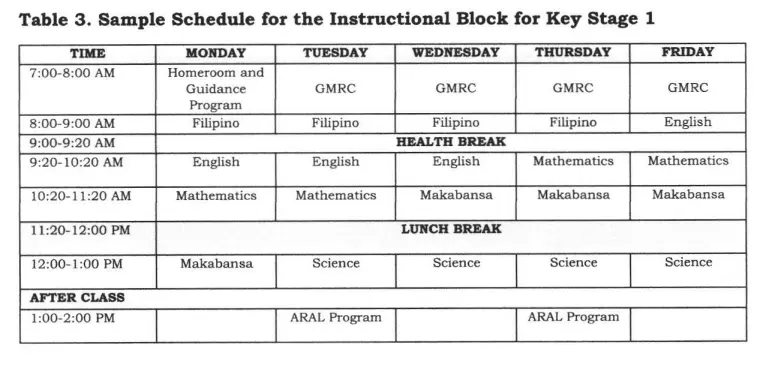
Deped Kindergarten Class Program (Portrait Template)
Deped Kindergarten Class Program (Landscape Template)
Deped Kindergarten Class Program (Excel Template)
3. MATATAG Curriculum and Kindergarten: What You Need to Know
The MATATAG Curriculum is DepEd’s revamped K-10 educational framework, designed to address learning poverty gaps and reduce curriculum congestion. It officially began implementation in SY 2024–2025 — and Kindergarten was part of the very first wave.
MATATAG Phased Implementation Timeline
School Year | Grade Levels Covered |
SY 2024–2025 (Phase 1) | Kindergarten, Grade 1, Grade 4, Grade 7 |
SY 2025–2026 (Phase 2) | Grade 2, Grade 5, Grade 8 |
SY 2026–2027 (Phase 3) | Grade 3, Grade 6, Grade 9 |
SY 2027–2028 (Phase 4 – Full) | Grade 10 (Complete K-10 rollout) |
Since Kindergarten was implemented in Phase 1, by SY 2026–2027, Kinder teachers are now entering their third year with MATATAG. This means most teachers should already be familiar with the framework — but the new Three-Term Calendar adds fresh considerations for class program planning.
What Makes the MATATAG Kindergarten Curriculum Different?
- Play-based, thematic learning — content is delivered through intertwined themes, not isolated subjects
- Holistic development — covers cognitive, physical, social-emotional, and values domains simultaneously
- Teacher as facilitator — teachers guide discovery rather than deliver passive lessons
- Integrated programs — the Homeroom Guidance Program (HGP) is embedded into classroom activities, not treated as a separate subject
Share to your friends!
4. Kindergarten Blocks of Time: The Core Framework
The most important thing to understand about the Kindergarten class program is that it does not follow a subject-by-subject schedule. Instead, it uses a structured daily flow called Blocks of Time, where various learning domains are woven together throughout the day.
Here are the main Blocks of Time found in a typical Kindergarten class program:
Morning Routine Block
- Arrival and settling in
- Morning exercises / physical warm-up
- Opening activities (flag ceremony, prayers, greetings)
- Attendance and calendar activities
Language, Communication, and Literacy (LCL) Block
- Read-aloud sessions, storytelling, oral language activities
- Early literacy skills: phonological awareness, print concepts
- Writing readiness activities
- Mother Tongue-based activities
Numeracy and Cognitive Development Block
- Number concepts and early math skills
- Pattern recognition, sorting, classifying
- Problem-solving through play and manipulatives
Creative Arts and Motor Development Block
- Drawing, painting, crafting
- Music and movement activities
- Fine and gross motor skill development
Personal and Social Development Block
- Values formation and Good Manners and Right Conduct (GMRC)
- Social interaction activities, cooperative play
- Sharing and community-building exercises
Free Play / Structured Play Block
- Child-initiated exploration
- Learning centers (reading corner, math corner, science corner, art corner)
- Supervised outdoor play
End-of-Day Routine Block
- Review of the day’s lessons through group sharing
- Preparation for dismissal
- Packing away, goodbye routines
Pro Tip for Teachers: The Blocks of Time are suggested, not absolute. You have the flexibility to adjust the sequence based on your learners’ energy levels throughout the day — for example, placing higher-focus activities like literacy and numeracy in the morning when children are most alert.


5. Assessment in Kindergarten: No Grades, Just Observation
One of the most distinctive features of the DepEd Kindergarten class program is its approach to assessment. Unlike Grade 1 and above, Kindergarten learners are NOT given numerical grades.
Instead, assessment is done through:
- Regular and continuous observation of the child’s behavior and development
- Anecdotal records — brief written notes documenting specific observable behaviors
- Portfolio assessment — collections of the child’s work over time
- Checklist-based monitoring of developmental milestones across all domains
This approach is rooted in the understanding that 5- to 6-year-olds learn best through play and exploration, and that formal testing would be both developmentally inappropriate and counterproductive.
For parents reading this: If your child’s Kindergarten teacher doesn’t send home a report card with numbers, don’t worry — that is exactly how it’s supposed to be. What matters is that your child is reaching developmental milestones in communication, social skills, physical development, and early numeracy and literacy.
Disclaimer:
Some educational materials may be inspired by or aligned with DepEd curriculum standards.
However:
All materials uploaded or created are intended to support teachers and students.
If any copyrighted content is unintentionally shared, please contact us here depedlibre@gmail.com immediately for removal or proper attribution.
We respect intellectual property rights and respond promptly to valid copyright concerns.
Frequently Asked Questions
Q: When does the SY 2026–2027 school year start? A: The school year officially opens on June 8, 2026 and ends on April 8, 2027, covering a total of 201 class days.
Q: Is the MATATAG Curriculum already required for Kindergarten in 2026? A: Yes. Kindergarten was among the first grade levels to implement the MATATAG Curriculum starting SY 2024–2025. By SY 2026–2027, it is in its third year of implementation.
Q: How many minutes per day should a Kindergarten class run? A: The total instructional time is 300 minutes (5 hours) per day, with a separate 1-hour break for recess and lunch, making the total school stay 6 hours. Teachers must also spend 2 hours on non-teaching tasks such as paperwork and lesson preparation.
Q: Do Kindergarten teachers still need to submit a class program? A: Absolutely yes. The class program must be submitted to the PSDS In-Charge and must comply with DepEd Order No. 009, s. 2026 and DepEd Order No. 010, s. 2024.
Q: Are there separate grades for the HGP and ARAL Program in Kindergarten? A: No. Both the HGP and the ARAL Program are not graded in Kindergarten. They are integrated into regular activities.
Q: Can private schools use the same class program format? A: Private schools may adopt the Three-Term Calendar structure, but they must comply with all legal requirements on minimum class days. The MATATAG Curriculum Guide is also available for reference, even for private schools that choose to adapt it.
Q: What is the Blocks of Time approach in Kindergarten? A: Instead of a subject-by-subject schedule, Kindergarten uses Blocks of Time — structured daily periods where multiple learning domains are addressed together through integrated, thematic activities. This is more developmentally appropriate for young learners.
Don’t forget to Follow our Facebook page for more free learning materials!
Latest News!
Download more files below!
- Adviser Files
- Aral Program Materials
- Brigada Eskwela Files
- COT Lesson Plans
- Daily Lesson Log (DLL)
- Deped Files
- Deped Modules
- Graduation Program/Files
- Homeroom Guidance Modules
- Matatag Curriculum Guide
- Matatag Lesson Exemplars
- National Learning Camp Files
- NAT Reviewer (New)
- Periodical Test (All Subjects)
- PowerPoint Game Templates
- Summative Tests/ Perfor Task
- Teacher Loans


Recent Posts
Download (by grade level)!
Grade 9 Files
Grade 10 Files
Grade 11 Files
Grade 12 Files