
DepEd Class Program for Key Stage 4 SY 2026 – 2027

DepEd Class Program for Key Stage 4 2026: The Complete Implementation Guide
Introduction
The Department of Education’s overhaul of the Philippine K to 12 system represents one of the most significant educational reforms in recent years. For schools implementing the DepEd class program for Key Stage 4 in 2026, understanding how to balance the new MATATAG Curriculum with the three-term school calendar is essential for success.
This comprehensive guide walks you through every aspect of structuring effective class programs for Grades 11 and 12, providing insights that go beyond what you’ll find in official documents. Whether you’re a school administrator, teacher, or education specialist, this article equips you with actionable strategies to create schedules that maximize learning outcomes.
Table of Contents
What is Key Stage 4? Understanding the Framework
Defining Key Stage 4 in Philippine Education
Key Stage 4 refers to Grades 11 and 12—the final two years of the 13-year basic education cycle. This stage is critical because it represents the bridge between secondary education and tertiary or vocational pathways.
Key Stage | Grade Levels | Age Range | Duration |
Key Stage 1 | Kindergarten – Grade 3 | 4–8 years old | 4 years |
Key Stage 2 | Grades 4–6 | 9–11 years old | 3 years |
Key Stage 3 | Grades 7–10 | 12–15 years old | 4 years |
Key Stage 4 | Grades 11–12 | 16–17 years old | 2 years |
Why Key Stage 4 Matters in 2026
The transition to the three-term school calendar for the 2026–2027 school year fundamentally changes how Key Stage 4 operates. Unlike the traditional four-quarter system, the new structure consists of:
- First Term: Extended instructional period with formative assessments
- End-of-Term Block: Dedicated time for summative assessment and remediation
- Second and Third Terms: Repeated cycle with deeper learning objectives
This design particularly benefits Key Stage 4 learners because it allows for:
- Sustained focus on complex, specialized subjects
- Work immersion preparation without rushing through content
- Flexible pacing for students pursuing different career tracks
The MATATAG Curriculum and Key Stage 4
Understanding MATATAG’s Connection to Key Stage 4
The MATATAG Curriculum (Matatag, Magaling, Makabago) is DepEd’s response to learning recovery and curriculum enhancement. While lower Key Stages have seen phased MATATAG implementation starting SY 2024–2025, Key Stage 4 (Grades 11–12) currently operates under the Senior High School (SHS) Curriculum Framework.
Important Note: The SHS curriculum guidelines in DepEd Order No. 021, s. 2019, and DepEd Order No. 012, s. 2020, remain in effect until MATATAG integration is formally implemented for Grades 11–12.
Key Stage 4 Curriculum Components
The Key Stage 4 curriculum consists of 31 subjects accounting for 2,480 hours across two years, distributed across:
Core Subjects (Compulsory)
- General Science
- General Mathematics
- Effective Communication (English)
- Mabisang Komunikasyon (Filipino)
- Kasaysayan at Lipunang Pilipino (History and Social Studies)
- Physical Education
- Health Education
- Music and Arts
Track-Specific Subjects:
- Academic Track electives
- Applied Track (vocational and technical)
- Specialized subjects aligned with career paths
Download here the DepEd Class Program for Key Stage 4 SY 2026 – 2027!
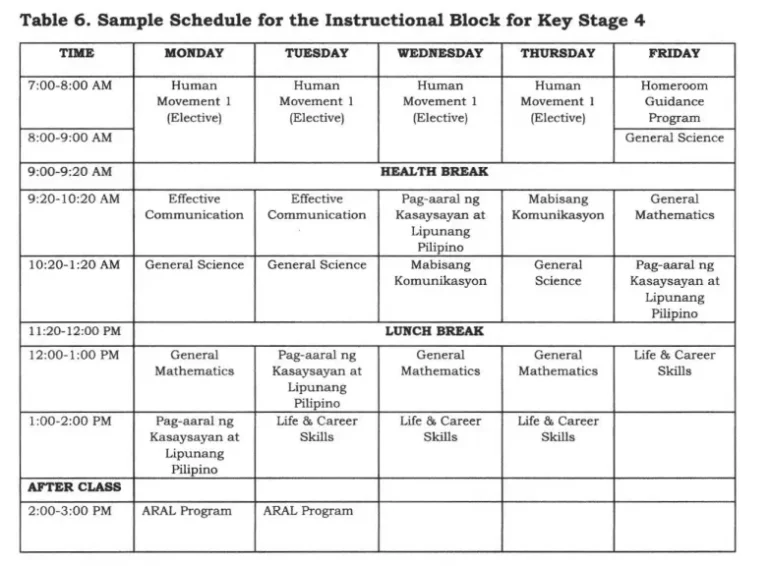
Structuring the DepEd Class Program for Key Stage 4
Components of a Balanced Class Program
A well-designed DepEd class program for Key Stage 4 must balance multiple elements to support holistic learner development:
- Academic Subject Blocks
These form the foundation of daily instruction. Core subjects receive consistent weekly time allocations:
- Core Subjects: 60% of total instructional time
- Electives and Specialized Subjects: 30% of total instructional time
- Physical Education & Wellness: 10% of total instructional time
- Homeroom and Guidance Periods
Starting the day with Homeroom and Guidance (20–30 minutes) establishes:
- Attendance procedures and daily announcements
- Mental health check-ins and wellness discussions
- College and career guidance topics
- Values formation activities
This is especially crucial for Key Stage 4 learners navigating post-secondary decisions.
- Physical Development and Human Movement
Contrary to popular belief, Senior High School shouldn’t abandon physical education. The class program should allocate:
- 2 hours per week minimum for Physical Education
- 1 hour per week minimum for Health and Wellness
- 15-minute movement breaks between intensive academic blocks
- Career Preparation and Work Readiness
Key Stage 4 learners preparing for work immersion need:
- Life and Career Skills modules (integrated into class program)
- Internship coordination periods for senior students
- Specialized technical skills training for applied track students
- Break Times and Wellness Periods
Effective class programs include:
- Morning break: 15 minutes (after 2 hours of classes)
- Lunch break: 45–60 minutes (midday nutrition and rest)
- Afternoon break: 15 minutes (for afternoon sessions)
Pro Tip: Never schedule high-demand subjects (like Mathematics) immediately after lunch when student energy is lowest. Reserve post-lunch periods for collaborative learning, labs, or discussion-based classes.
Share to your friends!
Implementing the Three-Term Calendar for Key Stage 4
How the Three-Term Structure Works
Unlike the traditional four quarters, the three-term calendar for 2026–2027 operates as follows:
School Year 2026–2027 Timeline:
- Start Date: June 8, 2026
- End Date: April 8, 2027
- Total Class Days: 201
Term Breakdown:
Term | Duration | Instructional Days | Summative Testing |
1st Term | June–August | ~60 days | Day 15 & Day 30 |
Break Period | August 15–31 | — | Remediation/Enrichment |
2nd Term | September–December | ~70 days | Day 15 & Day 30 |
Break Period | December 24–January 5 | — | Holiday break |
3rd Term | January–April | ~70 days | Day 15 & Day 30 |
Key Stage 4 Adjustments for Three-Term Implementation
Grade Computation Changes:
- Elimination of Quarter weights: No more Q1, Q2, Q3, Q4 averaging
- Trimester weighting:
- Written Work (WW): 20%
- Performance Tasks (PT): 50%
- Summative Test (ST): 30%
- Work Immersion subjects: Special 70% PT / 30% Written Task ratio
Schedule Flexibility:
- Class programs can adjust instructional blocks based on term-specific priorities
- Remediation periods built into end-of-term blocks don’t reduce instructional time
Senior High School work immersion (6 weeks) integrates into the calendar without disrupting core learning


Preparing Your School for Key Stage 4 Implementation in 2026
Pre-Implementation Checklist (Months 1–3)
- Review and understand DepEd Order No. 010, s. 2024 (MATATAG implementation)
- Audit current facilities and technology infrastructure
- Identify specialized teachers and their availability
- Survey students about track preferences (Academic vs. Applied)
- Draft initial class program templates
- Organize faculty training workshops on three-term assessment
Implementation Checklist (Month 4–5)
- Finalize class programs in consultation with stakeholders
- Distribute programs to teachers for feedback
- Set up ECR systems and train teachers on three-term grading
- Coordinate with partner organizations for work immersion placements
- Establish ARAL implementation timeline for at-risk learners
- Brief parents on schedule changes and assessment structure
Post-Implementation Monitoring (Month 6 onwards)
- Monitor schedule effectiveness through weekly staff feedback
- Track student performance data across the first term
- Adjust class programs based on enrollment and teacher availability
- Document lessons learned for continuous improvement
Share best practices across departments
Disclaimer:
Some educational materials may be inspired by or aligned with DepEd curriculum standards.
However:
All materials uploaded or created are intended to support teachers and students.
If any copyrighted content is unintentionally shared, please contact us here depedlibre@gmail.com immediately for removal or proper attribution.
We respect intellectual property rights and respond promptly to valid copyright concerns.
Conclusion: Building Success for Key Stage 4 in 2026
The DepEd class program for Key Stage 4 in 2026 represents more than a schedule—it’s a strategic framework for preparing students for post-secondary success. By balancing academic rigor with practical career preparation, incorporating wellness and guidance, and leveraging the three-term calendar’s structure, schools create environments where Grade 11 and 12 students thrive.
The transition to three-term scheduling, while challenging initially, offers unprecedented flexibility for remediation, enrichment, and work immersion. With careful planning, stakeholder collaboration, and strategic use of available resources, your school can implement an exemplary Key Stage 4 program that serves all learners.
Remember: The best class program is one that evolves based on your school’s unique context, student needs, and available resources. Use this guide as a foundation, customize it for your reality, and commit to continuous improvement as you implement.
Don’t forget to Follow our Facebook page for more free learning materials!
Latest News!
Download more files below!
- Adviser Files
- Aral Program Materials
- Brigada Eskwela Files
- COT Lesson Plans
- Daily Lesson Log (DLL)
- Deped Files
- Deped Modules
- Graduation Program/Files
- Homeroom Guidance Modules
- Matatag Curriculum Guide
- Matatag Lesson Exemplars
- National Learning Camp Files
- NAT Reviewer (New)
- Periodical Test (All Subjects)
- PowerPoint Game Templates
- Summative Tests/ Perfor Task
- Teacher Loans



Recent Posts
Download (by grade level)!
Grade 9 Files
Grade 10 Files
Grade 11 Files
Grade 12 Files