DepEd PMES Template Free Download

DepEd PMES Template Free Download: The Ultimate Guide for Filipino Teachers (SY 2025–2028)
Are you a Filipino public school teacher feeling overwhelmed by the new DepEd Performance Management and Evaluation System? You’re definitely not alone. Every school year, thousands of teachers scramble online looking for the right PMES templates, forms, and tools — and this year is no different, especially with the rollout of the groundbreaking Multi-Year PMES covering SY 2025–2026 all the way through SY 2027–2028.
This guide gives you everything you need in one place: what PMES is, why it matters, what has changed, and most importantly — where and how to download your free DepEd PMES templates right now.
Bookmark this page. You’ll want to come back to it.
Table of Contents
- What Is DepEd PMES?
- What’s New: The Multi-Year PMES (SY 2025–2028)
- Who Does PMES Apply To?
- Complete List of PMES Tools and Templates
- DepEd PMES Template Free Download — Direct Links
- Understanding the PMES Annual Timeline
- Classroom Observation Under the New PMES
- Career Stages and Differentiated Evaluation
- How to Fill Out Your e-IPCRF
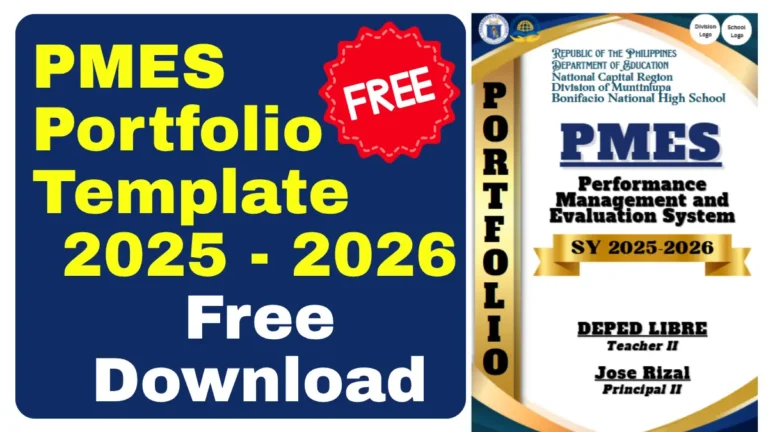
- PMES Portfolio: Do You Still Need One?
- Tips to Pass Your PMES Evaluation
- Frequently Asked Questions
What Is DepEd PMES?
The Performance Management and Evaluation System (PMES) is DepEd’s official framework for assessing the performance of public school teachers across the Philippines. It replaced the older RPMS (Results-Based Performance Management System) and is fully anchored on the Philippine Professional Standards for Teachers (PPST) — the benchmark that defines what good teaching looks like at every career stage.
Think of PMES as more than just a ratings system. It’s designed to:
- Recognize teachers who are performing well and reward professional excellence
- Guide teachers toward continuous improvement through coaching and mentoring
- Standardize how performance is measured, so evaluations are fair, objective, and consistent
- Connect classroom practice to the broader goals of DepEd and the national curriculum
At its core, PMES values your growth as an educator — not just your paperwork compliance.
What's New: The Multi-Year PMES (SY 2025–2028)
On October 1, 2025, DepEd issued Memorandum No. 089, s. 2025, officially launching the Guidelines on the Multi-Year Performance Management and Evaluation System for Teachers from School Years 2025–2026 to 2027–2028. This is the biggest restructuring of teacher evaluation in recent years.
“This Memorandum establishes comprehensive guidelines for assessing and improving teacher performance over school years, thereby addressing the need for continuity and consistency in teachers’ performance management and evaluation, pursuant to the PPST, while streamlining and simplifying the process and requirements involved.” — DepEd Memorandum No. 089, s. 2025
Key Changes Under DM 089, s. 2025
Feature | Old PMES | New Multi-Year PMES |
Cycle Length | Annual | 3-Year Cycle (2025–2028) |
PPST Indicators Per Year | All indicators assessed | 14 indicators per school year |
Classroom Observations | 4 per year | 2 per year (1 for SY 2025–2026) |
Physical Portfolio | Required | No longer required |
Document Duplication | Required per objective | Crosscutting documents — no duplication |
Coverage | SY-specific | Covers all 37 PPST indicators across 3 years |
What This Means for You
If you were exhausted by annual portfolio submissions and multiple classroom observations — breathe. The new PMES has been explicitly designed to reduce teacher burden while maintaining the integrity of performance evaluation. Physical portfolios are out. Duplicate documents are out. Flexibility is in.
For SY 2025–2026 specifically, DepEd has further clarified (through guidance issued in March 2026) that only one (1) full-period classroom observation is required for performance evaluation — down from the usual two.
Who Does PMES Apply To?
The Multi-Year PMES applies to all public school teachers in the Philippines, specifically:
- Teachers I to VII (including Beginning, Proficient, and Highly Proficient career stage teachers)
- Master Teachers I to V
- Teachers in the Alternative Learning System (ALS)
- Teachers in the Madrasah Program
- Teachers in the Special Needs Education (SNED) Program
- Teachers in the Special Science Education Program
- Teachers in Indigenous Peoples Education (IPEd)
If you are a public school teacher in any of these categories, this guide — and the downloadable templates below — are for you.
Share to your friends!
DepEd PMES Template Free Download
✅ Great news — you can download all official DepEd PMES templates for free!
Complete List of PMES Tools and Templates
Here is a complete breakdown of all the official PMES tools and forms released under DM 089, s. 2025 for SY 2025–2028:
Annex A — Teacher Self-Assessment Tool (SAT)
- Format: Excel-based
- Purpose: Allows teachers to conduct a self-assessment based on their assigned PPST indicators before the school year begins
- Who fills it out: The teacher (ratee)
Annex B — Instructional Supervision (IS) Plan Template
- Format: Word/Excel
- Purpose: Guides the schedule and focus of classroom observations and coaching sessions
- Who fills it out: The rater (school head or designated observer), in coordination with the teacher
Annex C-1 to C-4 — PMES Tools per Career Stage
These differentiated tools ensure that every teacher is evaluated fairly based on their position and career stage:
- Annex C-1: PMES Tool for Beginning towards Proficient Teachers (Teachers I–III)
- Annex C-2: PMES Tool for Proficient Teachers (Teachers IV–VII)
- Annex C-3: PMES Tool for Highly Proficient Teachers (Master Teachers I–II)
- Annex C-4: PMES Tool for Distinguished Teachers (Master Teachers III–V)
Annex D — Performance Monitoring and Coaching Form (PMCF)
- Format: Word/Excel
- Purpose: Tracks feedback given during coaching sessions throughout the school year
- Who fills it out: The rater, shared with the ratee
Annex E-1 to E-4 — Classroom Observation Tools (COT)
The COT bundle includes:
- E-1: COT Rubric (differentiated by career stage)
- E-2: COT Rating Sheet
- E-3: COT Observation Notes Form
- E-4: COT Inter-Observer Agreement Form (used when two observers conduct the same observation)
Annex F — Electronic IPCRF (e-IPCRF Tool)
- Format: Excel-based
- Purpose: The official form for encoding and submitting final performance ratings
- Important: All teachers must use this digital format — no printed or handwritten IPCRF will be accepted
Powered By EmbedPress



Understanding the PMES Annual Timeline
The PMES cycle is divided into four phases every school year. Here’s what happens in each:
Phase I — Planning & Commitment
- When: One month before to one month after class opening
- Key Activities: Teacher submits SAT, rater and ratee agree on PPST indicators (COIs and NCOIs) for the year, IS Plan is prepared
- Key Forms: IPCRF (Part I–III), SAT (Annex A), IS Plan (Annex B)
Phase II — Monitoring & Coaching
- When: Throughout the entire school year
- Key Activities: Classroom observations are conducted, coaching and mentoring sessions take place, feedback is documented
- Key Forms: COT (Annex E), PMCF (Annex D)
Phase III — Mid-Year & Year-End Review
- When: Mid-Year: approximately 5 months after class opening; Year-End: after the last day of classes
- Key Activities: Rater and ratee review performance progress, finalize ratings, accomplishments are documented
- Key Forms: IPCRF (all parts), PMCF summary
Phase IV — Rewarding & Development
- When: After the end of classes, before the next school year
- Key Activities: Ratings are finalized and submitted, high performers are recognized, Individual Development Plans (IDPs) are prepared
- Key Forms: IPCRF Part IV (IDP section)
Classroom Observation Under the New PMES
One of the most anxiety-inducing parts of any teacher’s year is the classroom observation. Under the Multi-Year PMES, DepEd has made significant changes to reduce that stress.
How Many Observations Are Required?
- SY 2025–2026: Only one (1) full-period classroom observation is required
- SY 2026–2027 and 2027–2028: Two (2) full-period classroom observations per year
Flexibility in Scheduling
Under DepEd Memorandum No. 089, s. 2025 and subsequent guidance, teachers are given flexible scheduling options:
- Your first observation can take place during Q1, Q2, or as late as Q3
- Your second observation (in years when two are required) can take place in Q3 or Q4
- Observations must be mutually agreed upon between teacher and observer
- If you already had an observation before the memo was issued, it counts — as long as it was scheduled by agreement
What Observations Are Being Assessed?
Each observation focuses on your Classroom Observable Indicators (COIs) — the specific PPST competencies assigned to your career stage for that school year. The COIs are distributed across the three-year cycle, meaning you won’t be assessed on all 37 PPST indicators in a single year.
The Spirit Behind the Change
Good classroom observation isn’t a gotcha moment. It’s a mirror — showing you both your growth and your grit.
DepEd’s shift toward fewer, more meaningful observations mirrors international best practices from countries like Finland and Singapore, where teacher evaluation is designed to support professional growth rather than create anxiety.
Career Stages and Differentiated Evaluation
The Multi-Year PMES recognizes that a newly hired Teacher I and an experienced Master Teacher should not be evaluated the same way. Here’s how it breaks down:
Teacher Position | PPST Career Stage | COT Rubric Levels |
Teachers I, II, III | Beginning towards Proficient | Levels 2–6 |
Teachers IV–VII | Proficient | Levels 3–7 |
Master Teachers I–II | Highly Proficient | Levels 4–8 |
Master Teachers III–V | Distinguished | Levels 5–9 |
This differentiation ensures that your performance is measured against standards appropriate to your stage in the teaching profession — not a one-size-fits-all rubric.
Note for Beginning Teachers: Even if your position is Teacher I–III, your PPST indicators follow the Proficient career stage. However, your COT rubric ratings use the Beginning towards Proficient scale (Levels 2–6). This is intentional — it acknowledges you are developing toward proficiency, not expected to be there yet.
Disclaimer:
Some educational materials may be inspired by or aligned with DepEd curriculum standards.
However:
All materials uploaded or created are intended to support teachers and students.
If any copyrighted content is unintentionally shared, please contact us immediately for removal or proper attribution.
We respect intellectual property rights and respond promptly to valid copyright concerns.
Latest News!
Download more files below!
- Adviser Files
- Aral Program Materials
- Brigada Eskwela Files
- COT Lesson Plans
- Daily Lesson Log (DLL)
- Deped Files
- Deped Modules
- Graduation Program/Files
- Homeroom Guidance Modules
- Matatag Curriculum Guide
- Matatag Lesson Exemplars
- National Learning Camp Files
- NAT Reviewer (New)
- Periodical Test (All Subjects)
- PowerPoint Game Templates
- Summative Tests/ Perfor Task
- Teacher Loans