CPD units for Teachers
CPD Units for Teachers in the Philippines: List of Free Seminars
Let’s be honest — when most teachers hear the words “CPD units,” their first reaction is somewhere between a sigh and mild panic. Between preparing lesson plans, managing classrooms, attending flag ceremonies, and somehow still having a life, finding time to earn Continuing Professional Development units can feel like one more thing piled on an already overflowing plate.
But here’s the truth: CPD doesn’t have to be that complicated — or expensive. In fact, with the right information (which most articles don’t give you in one place), you can tick off your requirements without losing your weekends or draining your salary.
This guide covers everything you need to know about CPD units for teachers in 2026: what they are, how many you need, how to earn them for free, how to upload them to the PRC system, and what happens if you fall short. And yes — there’s a list of Free seminars with FREE CPD units.
Table of Contents
What Are CPD Units for Teachers?
Continuing Professional Development (CPD) refers to the structured process of tracking, documenting, and reflecting on the learning and growth you experience as a professional. Think of it as proof that you’re not standing still — that you’re actively becoming a better teacher.
In the Philippines, CPD is governed by Republic Act No. 10912, known as the Continuing Professional Development Act of 2016. Under this law, the Professional Regulation Commission (PRC) mandates the accumulation of CPD points for the renewal of Professional Identification Cards (PICs). These units can be earned through various learning channels, encompassing formal courses, informal workshops, and real-world on-the-job experiences.
Simply put: no CPD units = no PRC license renewal. That’s how important this is.
How Many CPD Units Do Teachers Need in 2025?
This is where a lot of confusion creeps in — and understandably so, because the number has changed over the years.
Here’s a quick timeline to clear things up:
| Period | Required CPD Units |
|---|---|
| Before 2022 | 45 units every 3 years |
| After December 2022 | 15 units every 3 years (new guidelines) |
| 2024 (Transition Year) | 15 units per year |
| 2025 | 20 units per year |
| 2026 | 30 units per year |
| 2027 onwards | 45 units per year |
Under the new guidelines after December 2022, all CPD Councils were directed to lower the CPD requirements to 15 units every 3 years. The 3-year period aligns with the renewal cycle of your teaching license.
However, the landscape is evolving. Effective January 1, 2024, CPD compliance became mandatory for renewing Professional Identification Cards, and CPD Undertakings would no longer be accepted. The transition period details require professionals to complete 15 CPD Credit Units in 2024, increasing to 20 CUs in 2025, and 30 CUs in 2026, with 45 CUs required annually from 2027 onwards.
Important Note for First-Time Renewers: If you’re renewing your PRC license for the very first time, you are exempt from the CPD requirement. This only kicks in starting from your second renewal cycle onwards.
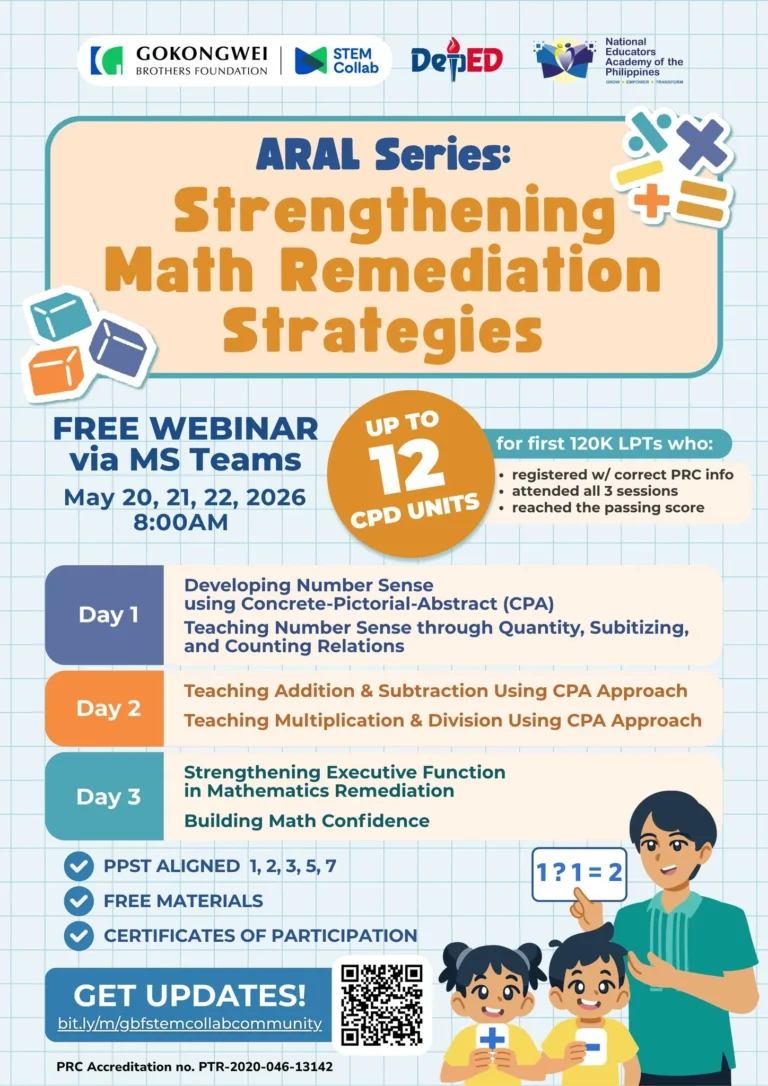
Teachers, let’s make Math Remediation more meaningful and engaging!
GBF STEM Collab and the National Educators Academy of the Philippines invite all teachers and ARAL tutors to our upcoming CPD-accredited webinar 𝐀𝐑𝐀𝐋 𝐒𝐞𝐫𝐢𝐞𝐬: 𝐒𝐭𝐫𝐞𝐧𝐠𝐭𝐡𝐞𝐧𝐢𝐧𝐠 𝐌𝐚𝐭𝐡 𝐑𝐞𝐦𝐞𝐝𝐢𝐚𝐭𝐢𝐨𝐧 𝐒𝐭𝐫𝐚𝐭𝐞𝐠𝐢𝐞𝐬, happening on May 20, 21, and 22, 2026 via MS Teams.
Visit our landing page for the webinar info and registration link: bit.ly/m/gbfstemcollabcommunity
Register here Click the Link here for Registration in the landing page
Up to 𝟏𝟐 𝐂𝐏𝐃 𝐮𝐧𝐢𝐭𝐬 will be given to the first 𝟏𝟐𝟎,𝟎𝟎𝟎 𝐋𝐏𝐓𝐬 who: registered with correct PRC info attended all 3 sessions reached the passing score
This 3-day FREE webinar aims to equip Key Stage 1 teachers with practical and effective strategies to help ARAL tutees: Develop number sense using the CPA approach
 Strengthen number sense through quantity, subitizing, and counting relations
 Learn basic mathematical operations meaningfully through the CPA Approach
 Build Math confidence
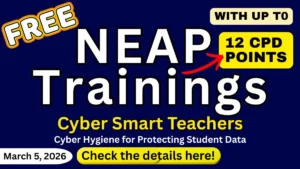
List of Seminars/Webinars with FREE CPD Units for Teachers

Share to your friends!
How Many CPD Units Do Teachers Need in 2026?
This is where a lot of confusion creeps in — and understandably so, because the number has changed over the years.
Here’s a quick timeline to clear things up:
| Period | Required CPD Units |
|---|---|
| Before 2022 | 45 units every 3 years |
| After December 2022 | 15 units every 3 years (new guidelines) |
| 2024 (Transition Year) | 15 units per year |
| 2025 | 20 units per year |
| 2026 | 30 units per year |
| 2027 onwards | 45 units per year |
Under the new guidelines after December 2022, all CPD Councils were directed to lower the CPD requirements to 15 units every 3 years. The 3-year period aligns with the renewal cycle of your teaching license.
However, the landscape is evolving. Effective January 1, 2024, CPD compliance became mandatory for renewing Professional Identification Cards, and CPD Undertakings would no longer be accepted. The transition period details require professionals to complete 15 CPD Credit Units in 2024, increasing to 20 CUs in 2025, and 30 CUs in 2026, with 45 CUs required annually from 2027 onwards.
Important Note for First-Time Renewers: If you’re renewing your PRC license for the very first time, you are exempt from the CPD requirement. This only kicks in starting from your second renewal cycle onwards.
Why CPD Requirements Keep Changing (And What That Means for You)
Many teachers feel frustrated by the moving goalposts, and that’s a completely valid reaction. Many teachers feel that this requirement places an extra burden on them, especially since most CPD programs come with a fee. Some teachers have expressed the hope that the Department of Education could offer more free training with CPD units to lessen the financial load on educators.
The good news? The government has heard this concern. The PRC has committed to officially recognizing the ongoing In-Service Training (INSET) sessions in schools and other seminars organized by the Department of Education as Continuing Professional Development units. This move aligns with the shared belief that commercial interests should not drive CPD unit acquisition but should be provided free of charge by the government.
This is a huge win for DepEd teachers — it means the trainings you’re already attending at school may soon count toward your PRC requirements.
The 5 Ways Teachers Can Earn CPD Units
Not all CPD learning looks the same, and that’s actually a good thing. The PRC recognizes multiple categories of CPD activities:
1. Formal Learning
These are structured, instructor-led courses with a defined curriculum — think graduate classes, certification programs, and accredited online courses. These typically yield the highest number of CPD units per activity.
2. Non-Formal Learning
Seminars, workshops, webinars, and short courses that are organized and structured, but don’t form part of a formal degree program. This is the most common way Filipino teachers earn CPD units.
3. Informal Learning
Informal learning refers to learning that occurs in daily life and which can contribute to a qualification. This includes reading professional journals, participating in community initiatives, and mentoring colleagues. PRC
4. Self-Directed Learning (SDL)
Self-study, online courses from non-accredited platforms, and personal research fall here. However, there is a cap: only a certain percentage of your total CPD units per compliance period can come from SDL. Always verify the current limit with the PRC or your CPD Council.
5. Professional Work Experience
Professional Work Experience refers to any participation that the professional gains while working in a specific field and workplace. This can include being a resource speaker, writing research papers, or holding leadership roles in professional organizations.
Where to Earn Free CPD Units in 2026
Let’s get to what most teachers actually want to know: Where can I earn CPD units without spending a fortune?
Here are the most reliable, legitimate, and free (or low-cost) options:
🏫 1. National Educators Academy of the Philippines (NEAP)
The National Educators Academy of the Philippines (NEAP) is the most popular and cost-free CPD provider for teachers employed by the Department of Education. It offers teachers a more affordable option to comply with CPD units for PRC license renewal.
NEAP is accredited by PRC and regularly conducts free e-learning programs. Watch their official Facebook page and the DepEd website for registration announcements — slots fill up fast.
- 📧 Contact: askneap@deped.gov.ph
- 🌐 Facebook: @DepEdNEAP
🌏 2. SEAMEO INNOTECH
Five of SEAMEO INNOTECH’s online courses have been accredited by the PRC for CPD units for teachers. Participants of Teach On, GURO 21 Course 1, GURO21 Course 2, TEACHeXCELS, and SUPEReXCELS will get 15 CPD credits upon their completion. SEAMEO INNOTECH
These courses are free, self-paced, and fully online. Here’s a summary:
| Course | Target | CPD Units |
|---|---|---|
| Teach On: Keeping the Passion Alive | All teachers | 15 |
| GURO21 Course 1 (21st Century Skills) | All teachers | 15 |
| GURO21 Course 2 (HOTS) | All teachers | 15 |
| TEACHeXCELS | School Heads | 15 |
| SUPEReXCELS | School Heads | 15 |
📧 To register: info@seameo-innotech.org
🎓 3. University of the Philippines Open University (UPOU)
The University of the Philippines Open University provides 24 free Massive Open Online Courses (MOOCs) covering topics in educational media, sustainable development, and distance education. However, not all MOOCs are PRC-accredited, so you should check the specific course you want to enroll in.
Always verify on the CPDAS portal before enrolling to confirm which courses carry accredited CPD units.
💻 4. DepEd INSET (In-Service Training)
As mentioned earlier, PRC has committed to recognizing DepEd INSET as official CPD activities. If you’re a DepEd teacher, keep copies of all your INSET certificates — they may be converted into CPD credit units.
📋 5. Free Webinars from Accredited Providers
Various universities, professional organizations, and NGOs regularly host free CPD-accredited webinars. Some groups and the government are now offering free CPD trainings, workshops, seminars, and webinars to help professionals get good education without spending a lot of money. They cover lots of topics and are easy to get to, even for people in far places.
Pro tip: Follow the CPDAS official portal (cpdas.prc.gov.ph) and join teacher Facebook groups that post announcements about free trainings.
What About Paid CPD Providers?
If free options aren’t enough to meet your requirements — especially as the annual targets increase toward 2027 — paid providers offer more flexible and varied courses.
Some well-regarded accredited providers include:
- Xepto Education – Specializes in ed-tech, online pedagogy, and modern classroom tools
- OEd PostGrad – Offers online CPD covering teaching methodologies, classroom management, and digital tools like Google Classroom and Moodle
- Philippine CPD Online – Primarily health-focused but expanding to other professions
When choosing a paid provider, always:
- ✅ Verify they are listed on cpdas.prc.gov.ph as an accredited provider
- ✅ Confirm the specific course carries CPD credit units
- ✅ Check how many units the course grants before enrolling
In-Service Training from Non-Accredited Providers: Can It Count?
Yes — with extra steps. In-service trainings provided by non-accredited CPD providers can still contribute to a teacher’s CPD requirements, but they must be applied for and converted to CPD credit units by the concerned CPD Council. Teachers can apply for these units under the Self-Directed Learning and/or Lifelong Learning categories.
So if your school hosted a training from a non-PRC-accredited provider, don’t throw away that certificate. Gather your documentation and apply for conversion through the CPD Council for Professional Teachers. Just remember the SDL cap applies here.
Disclaimer:
Some educational materials may be inspired by or aligned with DepEd curriculum standards.
However:
All materials uploaded or created are intended to support teachers and students.
If any copyrighted content is unintentionally shared, please contact us here depedlibre@gmail.com immediately for removal or proper attribution.
We respect intellectual property rights and respond promptly to valid copyright concerns.
Frequently Asked Questions About CPD Units for Teachers
Q: Does my first PRC license renewal require CPD units? A: No. First-time renewers are exempt from the CPD requirement.
Q: Can I earn all my CPD units online? A: Yes, as long as the online courses are from PRC-accredited providers and the specific course carries CPD credit units.
Q: How do I know if a seminar or webinar is CPD-accredited? A: Check the CPDAS portal (cpdas.prc.gov.ph) and look for the provider in the accredited list. You can also ask the organizer directly for their PRC accreditation number.
Q: Can I earn CPD units through research or publishing? A: Yes. Research publication and being a resource speaker in professional activities qualify under certain CPD categories. The number of units granted depends on PRC’s evaluation.
Q: Is there a limit to how many units I can earn through self-directed learning? A: Yes. PRC limits the percentage of your total CPD units that can come from self-directed learning. Always check the current guidelines from the CPD Council for Professional Teachers.
Q: What if my CPD certificate is lost? A: Contact the training provider for a replacement copy. Always save digital copies of all your CPD certificates immediately after receiving them.
Don’t forget to Follow our Facebook page for more free learning materials!
Latest News!
Download more files below!
- Adviser Files
- Aral Program Materials
- Brigada Eskwela Files
- COT Lesson Plans
- Daily Lesson Log (DLL)
- Deped Files
- Deped Modules
- Graduation Program/Files
- Homeroom Guidance Modules
- Matatag Curriculum Guide
- Matatag Lesson Exemplars
- National Learning Camp Files
- NAT Reviewer (New)
- Periodical Test (All Subjects)
- PowerPoint Game Templates
- Summative Tests/ Perfor Task
- Teacher Loans
Recent Posts
Download (by grade level)!
Grade 9 Files
Grade 10 Files
Grade 11 Files
Grade 12 Files
Thanks