PMES Free Template Download 2025-2026
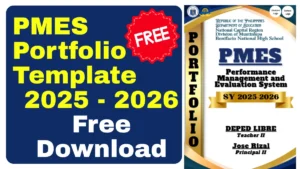
PMES Free Template Download 2025-2026: Your Complete Guide to Professional Portfolio Excellence
Are you looking for a reliable, professionally designed PMES free template download for 2025-2026? You’ve landed in exactly the right place. As a fellow educator who has navigated the evolving landscape of teacher performance evaluation systems in the Philippines, I understand the challenges you face when preparing your Performance Management and Evaluation System (PMES) portfolio.
The good news? You don’t have to start from scratch or spend hours formatting documents. This comprehensive guide will walk you through everything you need to know about free PMES templates for School Year 2025-2026, including where to download them, how to use them effectively, and insider tips to make your portfolio stand out during evaluation.
Let me share something personal: I remember the first time I had to compile my RPMS (now PMES) portfolio. I spent countless late nights organizing documents, formatting pages, and worrying whether I had everything right. That experience taught me the immense value of having a well-structured template. Now, I want to save you that struggle.
Table of Contents
- Understanding PMES 2025-2026: What’s New?
- Why You Need a PMES Template
- Free PMES Template Downloads for All Teacher Levels
- What’s Inside the PMES Portfolio Template
- Step-by-Step Guide to Using Your Template
- PMES vs RPMS: Understanding the Evolution
- Common Mistakes to Avoid
- Tips for a Standout Portfolio
- Frequently Asked Questions
- Additional Resources and Tools
1. Understanding PMES 2025-2026: What's New?
The Department of Education (DepEd) has introduced significant updates to the teacher performance evaluation system for School Years 2025-2026 through 2027-2028. Let’s break down what you need to know.
The Multi-Year PMES Framework
Under DepEd Memorandum No. 89, Series of 2025, the new Multi-Year Performance Management and Evaluation System brings a refreshing change to how teacher performance is assessed:
Key Changes at a Glance:
Aspect | Previous System (RPMS) | New System (PMES 2025-2026) |
Duration | Annual reset | Multi-year (3-year cycle: SY 2025-2028) |
Physical Portfolio | Required submission | No longer required ✓ |
Documentation Focus | Extensive paper trail | Self-monitoring with strategic evidence |
IPCRF Tool | Paper-based option | Excel-based electronic tool (mandatory) |
Classroom Observations | Varied frequency | 2 full-period observations per SY |
Document Duplication | Often required per objective | Cross-cutting documents accepted |
What This Means for You
The shift to PMES represents DepEd’s commitment to streamlining the evaluation process while maintaining high professional standards. Here’s what’s particularly exciting:
✓ No More Physical Portfolio Stress
You read that right! While maintaining organized documentation is still encouraged for your own professional growth and monitoring, you’re no longer required to submit bulky physical portfolios. This change alone saves teachers countless hours and printing costs.
✓ Smart Document Management
Documents that address multiple objectives can now be used across different Key Result Areas (KRAs) without duplication. For example, your lesson plan demonstrating differentiated instruction can count for multiple objectives instead of requiring separate copies.
✓ Focus on What Matters
The new system emphasizes meaningful professional development and actual teaching impact rather than paperwork volume.
The Seven Key Result Areas (KRAs)
Your PMES portfolio still revolves around seven critical areas aligned with the Philippine Professional Standards for Teachers (PPST):
- Content Knowledge and Pedagogy – Your mastery of subject matter and teaching methods
- Learning Environment and Diversity – Creating inclusive, safe learning spaces
- Curriculum and Planning – Effective lesson design and implementation
- Assessment and Reporting – Measuring and communicating student progress
- Community Linkages and Professional Engagement – Collaboration beyond the classroom
- Personal Growth and Professional Development – Continuous learning commitment
- Plus Factor – Outstanding contributions and innovations
Who Is Covered by PMES 2025-2026?
This memorandum applies to ALL teachers in:
- Public elementary schools
- Public secondary schools
- Alternative Learning System (ALS)
- Community learning centers
- Madrasah programs
- Special Needs Education
- Special science high schools
Whether you’re a newly hired Teacher I or a seasoned Master Teacher V, these guidelines affect your performance evaluation process.
2. Why You Need a PMES Template (Even If Physical Portfolios Aren't Required)
You might be thinking: “If physical portfolios aren’t mandatory anymore, why do I need a template?”
Great question! Let me explain why having a well-organized PMES template is still one of the smartest moves you can make this school year.
The Power of Personal Documentation
“Teaching without documentation is like building without blueprints—you might finish, but proving what you’ve accomplished becomes nearly impossible.”
Here are compelling reasons to maintain an organized PMES portfolio using templates:
- Self-Monitoring and Growth Tracking
Even without mandatory submission, DepEd explicitly encourages teachers to engage in self-monitoring and maintain personal records of accomplishments related to Non-Classroom Observable Indicators (NCOIs). Your template becomes your professional mirror, showing you:
- Areas where you’re excelling
- Competencies needing development
- Progress over time
- Evidence of continuous improvement
- Evaluation Readiness
While physical portfolios aren’t submitted upfront, your school head and approving authority will still verify your IPCRF ratings. Having organized documentation means you can quickly produce evidence when needed during:
- Mid-year review discussions
- End-of-year assessments
- Spot checks or verification processes
- Performance improvement planning
- Career Advancement Support
Planning to apply for:
- Promotion to Master Teacher positions?
- Transfer to another school?
- Special assignments or leadership roles?
- Professional recognition awards?
A comprehensive, template-organized portfolio becomes your professional showcase, demonstrating your qualifications far more effectively than scrambling to gather documents at the last minute.
- Time-Saving Efficiency
Picture this scenario: It’s November, and your principal requests evidence of your differentiated instruction strategies for a division-level report. Without a template:
- You spend hours searching email attachments
- You dig through folders looking for lesson plans
- You stress over whether you even saved those documents
With a template-organized portfolio:
- You navigate directly to KRA 3, Objective 7
- You retrieve your neatly filed evidence in minutes
- You confidently submit comprehensive documentation
Real Talk: I once witnessed a colleague spend an entire weekend trying to locate documents for a promotion application—documents she knew she had created but couldn’t find. Don’t be that teacher. Organization is self-care.
- Professional Credibility
When you do need to present documentation—whether to administrators, colleagues during LAC sessions, or evaluators—a professionally formatted template conveys:
- Attention to detail
- Organizational competence
- Professional commitment
- Respect for the evaluation process
First impressions matter, even in education. Your portfolio’s presentation speaks volumes about your professionalism.
Share to your friends!


- Check the other designs and PowerPoint templates below!
3. Free PMES Template Downloads for All Teacher Levels
Now for what you’ve been waiting for—the actual templates! I’ve compiled reliable sources for free, editable PMES templates tailored to different career stages.
Understanding Your Career Stage
Before downloading, identify which template matches your position:
Career Stage | Position Titles | PPST Level |
Beginning | Teacher I | Just starting your teaching journey |
Proficient | Teacher I, II, III | Demonstrating solid teaching competencies |
Highly Proficient | Teacher IV, V, VI, VII / Master Teacher I, II | Advanced teaching with mentorship roles |
Distinguished | Master Teacher III, IV, V | Master educators with systemic impact |
Official DepEd PMES Tools (2025-2026)
The most authoritative source is DepEd’s Human Resources Development Division (HRDD) official repository:
What You’ll Find:
- Individual Performance Commitment and Review Form (IPCRF) – Excel-based template
- Classroom Observation Tool (COT) forms
- Mid-Year Review Form (MRF)
- Guidelines and implementation manuals
- Means of Verification (MOV) checklists
Access Method: These materials are hosted on DepEd’s official Google Drive. You typically need:
- Active DepEd email account or
- Access granted by your school’s HR focal person
Note: While these are official templates, they focus on evaluation forms rather than portfolio compilation. For organized portfolio templates, continue to the next section.
Comprehensive PMES Portfolio Templates
For complete portfolio organization (combining all documents in one professional presentation), here are trusted resources:
For Teachers I-III (Beginning to Proficient)
Features to Look For:
- ✓ Cover page with school information
- ✓ Table of contents linked to sections
- ✓ KRA 1-7 dedicated sections
- ✓ Objective-based organization (Objectives 1-14)
- ✓ Space for annotations and reflections
- ✓ Professional design suitable for DepEd standards
File Formats Available:
- PowerPoint (.pptx) – Most popular, highly customizable
- Word (.docx) – Great for text-heavy documentation
- PDF – For final submission if required
For Teachers IV-VII (Highly Proficient)
Additional Features:
- ✓ Mentorship and coaching documentation sections
- ✓ Learning Action Cell (LAC) participation logs
- ✓ Collaborative planning evidence areas
- ✓ Leadership contribution spaces
For Master Teachers I-V (Distinguished)
Specialized Sections:
- ✓ Instructional leadership documentation
- ✓ Teacher development programs led
- ✓ Curriculum innovation contributions
- ✓ Research and best practice sharing
Editable Template Formats Explained
Understanding template formats helps you choose the right one:
PowerPoint Templates (.pptx)
- Pros:
- Easy to add images and visual evidence
- Professional slide-based organization
- Simple to navigate during virtual presentations
- Compatible with most devices
- Cons:
- Can become large files with many images
- Requires PowerPoint or compatible software
- Best For: Teachers who prefer visual organization and plan to present digitally
Word Document Templates (.docx)
- Pros:
- Familiar editing interface
- Better for text-heavy documentation
- Easier to print if needed
- Smaller file sizes
- Cons:
- Less visually dynamic
- Can be harder to organize diverse evidence types
- Best For: Teachers who prefer traditional document format
Canva Templates
- Pros:
- Beautiful, modern designs
- Cloud-based (access anywhere)
- Collaboration-friendly
- Easy drag-and-drop editing
- Cons:
- Requires internet connection
- Some features need Canva Pro subscription
- Exporting to specific formats may require premium
- Best For: Tech-savvy teachers wanting standout visual appeal
How to Download FREE Templates Safely
Before you click download on any template, follow these safety guidelines:
✓ Verify the Source
- Stick to recognized DepEd resources sites
- Check teacher community recommendations
- Avoid suspicious download links or sites requiring excessive permissions
✓ Check File Compatibility
- Ensure the format works with your software (Office 365, Google Workspace, etc.)
- Preview before fully downloading if possible
- Have backup software options ready
✓ Scan for Malware
- Use antivirus software to scan downloaded files
- Be cautious of .exe files (templates shouldn’t be executables)
- Download directly from source, not third-party upload sites
✓ Read Terms of Use
- Many templates are free for personal/educational use only
- Respect creators’ intellectual property
- Don’t resell or redistribute templates marked as personal use
4. What's Inside the PMES Portfolio Template
A comprehensive PMES portfolio template typically includes the following sections. Understanding each component helps you populate it effectively.
Front Matter
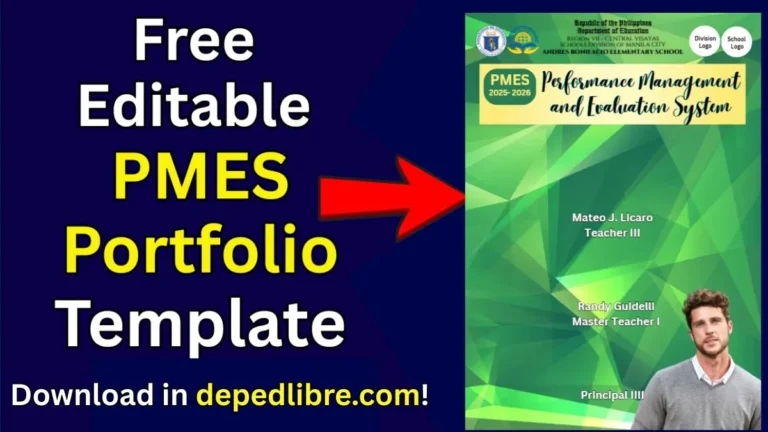
- Cover Page Your portfolio’s first impression should include:
- Department of Education official header
- DepEd and school division logo
- School name and address
- Your complete name and position
- Employee number and school ID
- School year coverage (2025-2026)
- Date of submission/compilation
Pro Tip: Use your school’s official templates for logos and formatting when available. Consistency with school branding shows professionalism.
- Table of Contents An organized TOC should list:
- All seven KRAs
- Individual objectives (1-14)
- Page numbers or slide numbers
- Annexes and supporting documents section
Navigation Tip: In PowerPoint templates, use hyperlinks on the TOC to jump directly to sections. This feature impresses during digital presentations!
- Vision, Mission, and Core Values Include:
- DepEd’s national vision and mission
- Your school division’s vision and mission
- Your school’s specific vision and mission
- Core values alignment statement
Why This Matters: This section demonstrates your understanding of how your individual performance connects to institutional goals—a key PPST competency.
Main Content Sections
- Teacher Profile A professional snapshot containing:
- Educational background and degrees
- Teaching certifications and licenses
- Years of teaching experience
- Current assignment and subjects taught
- Professional affiliations and memberships
- Training and seminars attended (recent 3 years)
- KRA 1: Content Knowledge and Pedagogy
This section addresses Objectives 1-2 and should contain evidence such as:
Objective 1: Applied knowledge of content within and across curriculum teaching areas
- Lesson plans demonstrating content mastery
- Interdisciplinary teaching examples
- Subject integration documentation
- COT ratings for content delivery
- Student work samples showing content understanding
Objective 2: Used research-based knowledge and principles of teaching and learning
- Lesson plans citing educational research
- Evidence of differentiated instruction
- Learning theories application in practice
- Action research proposals or completed studies
- Professional reading logs with reflections
- KRA 2: Learning Environment and Diversity of Learners
Covering Objectives 3-5:
Objective 3: Managed classroom structure to engage learners
- Classroom management plan
- Seating arrangement documentation
- Behavioral intervention strategies
- Time management evidence (class schedules, routines)
- Photos of organized learning spaces
Objective 4: Maintained learning environments that promote fairness, respect, and care
- Classroom rules created with student input
- Anti-bullying initiatives
- Inclusivity practices documentation
- Student feedback on classroom climate
- Conflict resolution records
Objective 5: Managed learner behavior constructively
- Positive behavior reinforcement systems
- Individual behavior improvement plans
- Parent communication logs regarding behavior
- Restorative justice practices
- Behavior tracking data
- KRA 3: Diversity of Learners
Objective 6:
Objective 6: Applied a range of teaching strategies to develop critical and creative thinking
- Differentiated lesson plans for diverse learners
- Individualized Education Plans (IEPs) for special needs
- Gifted and talented program participation
- Cultural responsiveness evidence
- Multilingual support strategies (MTB-MLE)
- Photos/videos of varied teaching strategies
- KRA 4: Curriculum and Planning
Objectives 7-9:
Objective 7: Planned, managed, and implemented developmentally sequenced teaching and learning processes
- Complete lesson plans (DLLs)
- Unit plans and quarter plans
- Curriculum maps
- Pacing guides
- Backward design examples
- Alignment with MELCs (Most Essential Learning Competencies)
Objective 8: Selected, developed, organized, and used appropriate teaching and learning resources
- Instructional materials inventory
- Self-made teaching aids (photos, descriptions)
- Digital resources utilized
- Library and learning resource coordination
- Technology integration examples
- Learning modules or workbooks developed
Objective 9: Participated in collegial discussions that use teacher and learner feedback
- LAC (Learning Action Cell) attendance records
- LAC session minutes and outputs
- Peer observation notes
- Professional learning community participation
- Collaborative planning documents
- Feedback from colleagues with action taken
- KRA 5: Assessment and Reporting
Objectives 10-12:
Objective 10: Designed, selected, organized, and used diagnostic, formative, and summative assessment strategies
- Table of Specifications (TOS) for tests
- Diagnostic test results and analysis
- Formative assessment examples (exit tickets, quizzes)
- Summative assessments (periodical tests)
- Performance-based assessments
- Rubrics for various assessment types
- Item analysis documentation
Objective 11: Monitored and evaluated learner progress and achievement
- Class record (properly maintained)
- Student progress tracking sheets
- Intervention programs for struggling learners
- Enrichment activities for advanced learners
- Data-driven instruction evidence
- Before-and-after comparison data
Objective 12: Communicated promptly and clearly the learners’ needs, progress, and achievement
- Parent-teacher conference logs
- Progress reports sent to parents
- Individual Learning Plans signed by parents
- Grade dissemination records
- Student recognition and awards
- Report cards with parent acknowledgment
- KRA 6: Community Linkages and Professional Engagement
Objective 13:
Objective 13: Established learning environments responsive to community contexts
- Community resource mapping
- Local context integration in lessons
- Partnerships with local organizations
- Community service initiatives
- Parent involvement programs
- Cultural events and celebrations
- Community-based projects
- KRA 7: Personal Growth and Professional Development
Objective 14:
Objective 14: Participated in professional development programs
- Certificate of participation in seminars/workshops
- Webinar completion certificates
- Graduate studies enrollment proof (if pursuing)
- Professional development plan (PDP)
- Training application and reflections
- Self-directed learning evidence
- Professional reading and research
- Plus Factor
This optional section can include:
- Awards and recognition received
- Innovation and best practices developed
- Published articles or research
- Significant community contributions
- Exemplary service beyond regular duties
- Leadership roles in organizations
- Mentorship of new teachers
Back Matter
- Annexes and Appendices Supporting documents that don’t fit cleanly into KRA sections:
- Full copies of certificates
- Additional photos
- Detailed project documentation
- Extended student work portfolios
- Letters of commendation
- Media coverage of your work
- Attestation and Certification
- Self-rating justification
- Signatures (teacher, rater, approving authority)
- Date of compilation
- Declaration of authenticity
Disclaimer:
Some educational materials may be inspired by or aligned with DepEd curriculum standards.
However:
All materials uploaded or created are intended to support teachers and students.
If any copyrighted content is unintentionally shared, please contact us immediately for removal or proper attribution.
We respect intellectual property rights and respond promptly to valid copyright concerns.
Latest News!
Download more files below!
- Adviser Files
- Aral Program Materials
- Brigada Eskwela Files
- COT Lesson Plans
- Daily Lesson Log (DLL)
- Deped Files
- Deped Modules
- Graduation Program/Files
- Homeroom Guidance Modules
- Matatag Curriculum Guide
- Matatag Lesson Exemplars
- National Learning Camp Files
- NAT Reviewer (New)
- Periodical Test (All Subjects)
- PowerPoint Game Templates
- Summative Tests/ Perfor Task
- Teacher Loans