Grade 7 Budget of Work (BOW) MATATAG 2026
Grade 7 Budget of Work (BOW) MATATAG 2026 — Complete Guide + Free Download
If you are a Grade 7 teacher in the Philippines right now, there is a good chance you have already heard about the big changes coming in School Year 2026–2027. The three-term calendar is officially rolling out, and with it comes an entirely reorganized Budget of Work (BOW) for Grade 7 — one that is built from the ground up to align with the MATATAG Curriculum.
Whether you are trying to download the files, understand how the BOW works under the new term structure, or simply make sure your lesson planning stays on track, this guide has everything you need in one place. And yes — all the Grade 7 BOW files are available here for free download.
Table of Contents
What Is the Budget of Work (BOW) and Why Does It Matter?
Before diving into the Grade 7 specifics, let’s quickly clear up what the BOW actually is — because it is more than just another DepEd document to file away.
The Budget of Work is an official instructional planning tool issued by the Department of Education (DepEd). Think of it as the master blueprint of your entire school year. It organizes:
- Learning competencies and skills per subject and grade level
- Suggested topics for each competency
- Teaching strategies and classroom activities
- Time allotments per topic, arranged by week
In short, the BOW tells you what to teach, when to teach it, and roughly how long to spend on each lesson. It feeds directly into your Daily Lesson Log (DLL), Weekly Lesson Plan (WLP), and other instructional materials.
For Grade 7 specifically, the BOW is especially critical right now because this is the first full year that Grade 7 operates under the MATATAG Curriculum with the new three-term school calendar.
Free Download: Grade 7 Budget of Work (BOW) MATATAG SY 2026–2027
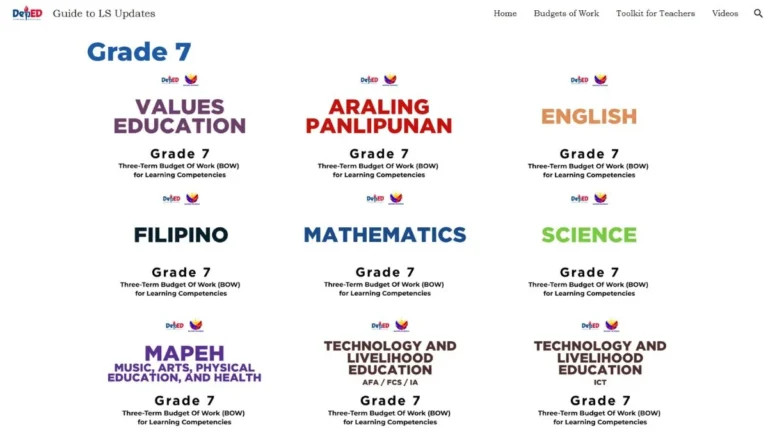
Good news — you do not need to pay for these files. The Grade 7 BOW documents are available here for free. These are sourced from the official DepEd Learning Systems Guide and are provided to help Filipino teachers access the materials they need without any barriers.
The download links below cover all Grade 7 subject areas:
Click and download below the Grade 7 MATATAG BOW (All Subjects)
Additional subject-specific BOW files:
The MATATAG Curriculum and Grade 7: What Changed?
The MATATAG Curriculum was introduced by DepEd as part of its broader reform agenda — “Bansang Makabata, Batang Makabansa” — which emphasizes stronger foundational learning, improved literacy, numeracy, and values formation for Filipino learners.
Grade 7 was part of the first wave of MATATAG implementation, which began in SY 2024–2025 covering Kindergarten, Grades 1, 4, and 7. By SY 2026–2027, Grade 7 teachers are now working within a fully established MATATAG framework — but with one major new addition: the shift from a two-semester calendar to a three-term school calendar.
The Three-Term School Calendar at a Glance
Implementation of the three-term structure starts in School Year 2026–2027, with each term having approximately 65 to 69 days of actual teaching and learning, excluding weekends and legal holidays.
Each term is organized into three blocks:
Block | Purpose |
Opening Block | Orientation, assessment, setting expectations |
Instructional Block | Core delivery of learning competencies |
End-of-Term Block | Assessment, remediation, enrichment, and review |
This structure is a significant departure from the old quarter-based setup. Instead of four quarters stretched across two semesters, teachers now plan across three distinct terms — each with a clear beginning, middle, and end.
Share to your friends!
Grade 7 Budget of Work: Subjects Covered
The Grade 7 BOW under the MATATAG Curriculum covers all the core and specialized learning areas required in Junior High School. Here is a complete breakdown of the subjects included:
Subject Area | Notes |
Filipino | Oral communication, reading, writing, grammar in Filipino |
English | Reading comprehension, writing, oral language, grammar |
Mathematics | Number sense, algebra, geometry, statistics and probability |
Science | Earth Science, Biology, Physics, Chemistry concepts |
Araling Panlipunan (AP) | History, geography, citizenship and society |
Edukasyon sa Pagpapakatao (EsP) | Values education and character formation |
MAPEH | Music, Arts, Physical Education, Health |
Technology and Livelihood Education (TLE) | Life and career skills, technical-vocational tracks |
Each of these subjects has its own BOW document that specifies which competencies must be covered in each term, along with the recommended time allotment per topic.
Important: The Grade 7 BOW is structured around three terms — not four quarters. This means if you are still using a quarter-based planning template, you will need to update your approach for SY 2026–2027.


How to Use the Grade 7 BOW Effectively
Downloading the BOW is just the first step. Here is a practical guide on how to actually use it to improve your classroom instruction:
- Identify Your BOW Version First
Make sure you are using the three-term MATATAG BOW for SY 2026–2027 — not the older MELC-based quarterly BOW. The competencies and time allotments are different, and using the wrong version can throw off your entire lesson planning calendar.
- Map Competencies Across the Three Terms
Once you have the correct BOW for your subject, sit down and map out which competencies fall in Term 1, Term 2, and Term 3. The BOW clusters competencies by week, so you can see at a glance what you need to cover and in what order.
- Integrate It into Your DLL and WLP
The BOW feeds directly into your Daily Lesson Log (DLL) or Detailed Lesson Plan (DLP). Use the weekly competency targets, time allotments, and suggested activities in the BOW as the basis for writing your DLL objectives and instructional sequences. The BOW provides a framework, not a script. Depedlibre
This is an important distinction. The BOW tells you what to teach and when — it does not replace your professional judgment about how to teach it. Your DLL is where you add your specific instructional strategies, learning activities, and assessment tools.
- Use the End-of-Term Block Wisely
One of the most practical improvements in the three-term BOW structure is the built-in End-of-Term Block. Do not treat this as empty time. Use it for:
- Formative and summative assessments
- Remediation sessions for learners who need additional support
- Enrichment activities for advanced learners
- Review and consolidation before moving to the next term
- Collaborate with Fellow Grade 7 Teachers
The BOW becomes even more powerful when used collaboratively. If your school has multiple Grade 7 sections, coordinate with co-teachers to ensure consistent pacing, share assessment materials, and discuss which competencies need more instructional time based on learner performance data.
Disclaimer:
Some educational materials may be inspired by or aligned with DepEd curriculum standards.
However:
All materials uploaded or created are intended to support teachers and students.
If any copyrighted content is unintentionally shared, please contact us here depedlibre@gmail.com immediately for removal or proper attribution.
We respect intellectual property rights and respond promptly to valid copyright concerns.
Common Questions Teachers Ask About the Grade 7 BOW
Q: Is the Grade 7 BOW official or just for orientation?
The BOW documents from DepEd’s Learning Systems (LS) Guide are released for orientation purposes while awaiting formal DepEd Orders. Teachers are encouraged to use them as working references while official orders are being finalized. Always check the DepEd official website and your school’s division office for the latest issuances.
Q: Can I use the old quarterly BOW for Grade 7 in SY 2026–2027?
It is strongly advised not to. Since the school year is now structured around three terms, using a quarterly BOW will create misalignment between your lesson pacing and the official school calendar.
Q: Where can I find the BOW for my specific subject area?
The official Grade 7 BOW files are hosted on the DepEd Learning Systems Guide website. You can also find them through the download links provided in this article below.
Q: Do I need a separate BOW for TLE tracks?
Yes. TLE in Grade 7 may have multiple tracks (e.g., Home Economics, ICT, Agriculture), and each track has its own set of competencies. Make sure you download the BOW that corresponds to the specific TLE track offered at your school.
Q: What if my learners are struggling to keep pace with the BOW schedule?
The BOW is a guide, not an absolute prescription. DepEd encourages teachers to exercise professional judgment. The End-of-Term Block is specifically designed to accommodate remediation and catch-up sessions. Document any adjustments you make in your instructional planning materials.
Don’t forget to Follow our Facebook page for more free learning materials!
Latest News!
Download more files below!
- Adviser Files
- Aral Program Materials
- Brigada Eskwela Files
- COT Lesson Plans
- Daily Lesson Log (DLL)
- Deped Files
- Deped Modules
- Graduation Program/Files
- Homeroom Guidance Modules
- Matatag Curriculum Guide
- Matatag Lesson Exemplars
- National Learning Camp Files
- NAT Reviewer (New)
- Periodical Test (All Subjects)
- PowerPoint Game Templates
- Summative Tests/ Perfor Task
- Teacher Loans


Recent Posts
Download (by grade level)!
Grade 9 Files
Grade 10 Files
Grade 11 Files
Grade 12 Files